
Carrot
Carrot family
16per square
cool 3 in apart. When soil reaches 60°F. Harvest: 70–95 days.
Long roots like a deeper 'top hat' square.
Long roots like a deeper 'top hat' square.
 LoamChart
Home Square Foot Gardening Chart
Mel Bartholomew’s method on one chart: how many plants fit in each square foot for 42 crops, the planting patterns inside the square, the trellis crops, when to plant and how much Mel’s Mix a bed needs. Then plan your own 4 × 4 bed.
The method gives every crop a fixed number of plants per 1 ft square: 16 small plants 3 in apart, 9 at 4 in, 4 at 6 in or 1 in the centre, with 8 peas or pole beans along a trellis and the biggest plants spread over several squares. Search for a crop or filter by count and season.
Showing 42 of 42 crops. 24 cool-season, 18 warm-season.
Carrot family

Cabbage family

Onion family

Onion family

Onion family

Beet and spinach family

Beet and spinach family

Cabbage family

Pea and bean family

Onion family

Onion family

Pea and bean family · climbs a trellis

Pea and bean family · climbs a trellis
Daisy family

Beet and spinach family

Carrot family

Grass family

Tomato family

Carrot family

Mint family

Carrot family

Mint family

Daisy family

Rose family

Squash family · climbs a trellis

Tomato family · climbs a trellis

Tomato family

Tomato family

Cabbage family

Cabbage family

Cabbage family

Cabbage family

Cabbage family

Cabbage family

Mallow family

Morning glory family

Tomato family

Squash family

Squash family · climbs a trellis

Squash family · climbs a trellis

Squash family · climbs a trellis

Squash family · climbs a trellis
Counts follow Mel Bartholomew’s method as published by the Square Foot Gardening Foundation and in UC and UW extension handouts. Days to harvest run from sowing or setting out (UGA C963, NDSU H-912, UGA C1039); setting-out times are from UNH Extension.
Inside each square the plants sit on an even grid, so every plant gets the same room. Read the seed packet’s “thin to” spacing: 3 in means 16 per square, 4 in means 9, 6 in means 4 and 12 in means 1. Choose a pattern to see it planted.
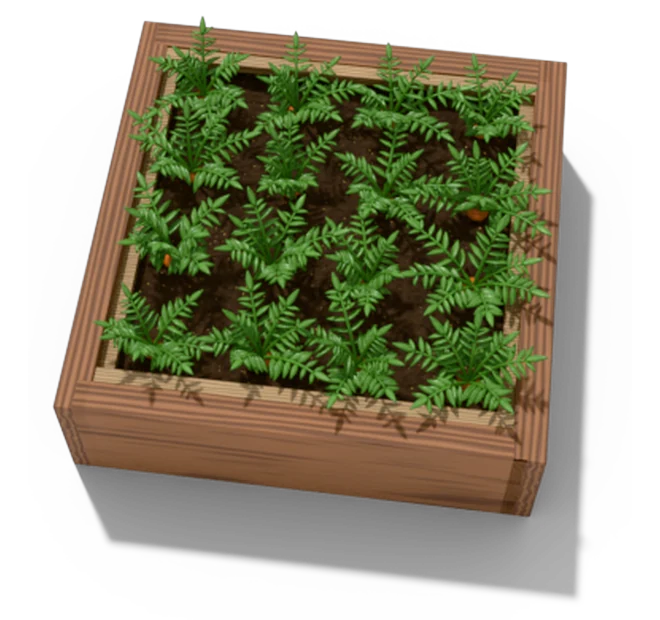
3 in apart, a 4 × 4 grid. Split the square into a 4 × 4 grid of 3 in boxes and sow one spot in the middle of each.
Crops at this spacing: carrot, radish, onion (bulb), green onion, chives.
Pick a crop, then select squares in the bed to plant them. North is at the top, where the trellis stands. The plan counts the plants, checks for tall crops shading short ones, climbers away from the trellis and crops that need several squares, and suggests what to sow next.
Pea 8Pole bean 8Cucumber 2Tomato 1Pepper 1Basil 4Swiss chard 4Marigold 4Leaf lettuce 4Beet 9Spinach 9Strawberry 4Carrot 16Radish 16Onion 16Bush bean 9Figure 3. Each square shows the crop planted at its count. Squares are 1 ft.
115 plants in 16 of 16 squares.
| Crop | Squares | Plants |
|---|---|---|
| Carrot | 1 | 16 |
| Radish | 1 | 16 |
| Onion (bulb) | 1 | 16 |
| Beet | 1 | 9 |
| Spinach | 1 | 9 |
| Bush bean | 1 | 9 |
| Pea | 1 | 8 |
| Pole bean | 1 | 8 |
| Basil | 1 | 4 |
| Swiss chard | 1 | 4 |
| Marigold | 1 | 4 |
| Leaf lettuce | 1 | 4 |
| Strawberry | 1 | 4 |
| Cucumber | 1 | 2 |
| Tomato (staked) | 1 | 1 |
| Pepper | 1 | 1 |
| Total | 16 | 115 |
Vining crops go up, not out. A trellis along the north side lets peas, pole beans and cucumbers fill a single square, and keeps a vining squash or melon to about 2 squares. Left to sprawl, a bush summer squash needs a 3 × 3 block.

| Pea | 8 per square | Trellis. Two rows of 4 along the trellis. |
|---|---|---|
| Pole bean | 8 per square | Trellis. Climbs the netting; keeps bearing if picked young. |
| Cucumber | 2 per square | Trellis. Train up the trellis; 1 per square if sprawling. |
| Tomato (staked) | 1 per square | Trellis. Vining types tied to a stake or trellis. |
| Tomato (bush) | 4 squares | Determinate types sprawl over a 2 × 2 block. |
| Summer squash | 9 squares | Bush zucchini fills a 3 × 3 block. |
| Winter squash | 2 squares | Trellis. Vining types; tie heavy fruit to the netting. |
| Melon | 2 squares | Trellis. Cradle each fruit in a sling. |
| Watermelon (small) | 2 squares | Trellis. Icebox types; support fruit with slings. |
| Pumpkin (small) | 2 squares | Trellis. Pie types only; big pumpkins need open ground. |
Setting-out times are counted from your average last spring frost. Enter that date to turn the weeks into calendar dates, with a first harvest estimated from the days to maturity.
Last frost Apr 20: 42 crops, earliest first. Crops planted by soil temperature or season show their rule instead of a date.
| Crop | Plant or set out | Rule | First harvest |
|---|---|---|---|
| Spinach | Mar 9 to Mar 30 | 3–6 weeks before last frost | Apr 18 to May 14 |
| Radish | Mar 23 to Apr 6 | 2–4 weeks before last frost | Apr 17 to May 6 |
| Onion (bulb) | Mar 23 | 4 weeks before last frost | Jul 1 to Jul 21 |
| Green onion | Mar 23 | 4 weeks before last frost | May 22 to Jun 21 |
| Turnip | Mar 23 to Apr 6 | 2–4 weeks before last frost | May 2 to Jun 5 |
| Leek | Mar 23 | 4 weeks before last frost | not listed |
| Leaf lettuce | Mar 23 to Mar 30 | 3–4 weeks before last frost | May 2 to May 19 |
| Broccoli | Mar 23 to Apr 6 | 2–4 weeks before last frost | May 22 to Jun 25 |
| Cabbage | Mar 23 | 4 weeks before last frost | Jun 1 to Jul 21 |
| Brussels sprouts | Mar 23 to Apr 6 | 2–4 weeks before last frost | Jun 21 to Jul 15 |
| Kale | Mar 23 | 4 weeks before last frost | May 12 to Jun 1 |
| Parsley | Mar 30 to Apr 6 | 2–3 weeks before last frost | Jun 8 to Jun 30 |
| Swiss chard | Apr 6 | 2 weeks before last frost | May 16 to May 21 |
| Potato | Apr 6 to Apr 13 | 1–2 weeks before last frost | Jun 15 to Jul 12 |
| Cauliflower | Apr 6 | 2 weeks before last frost | Jun 5 to Jun 20 |
| Bush bean | Apr 20 to Apr 27 | After last frost | Jun 9 to Jun 26 |
| Pole bean | Apr 20 to Apr 27 | After last frost | Jun 24 to Jul 11 |
| Celery | Apr 20 to Apr 27 | After last frost | not listed |
| Marigold | Apr 20 to Apr 27 | After last frost | not listed |
| Cucumber | Apr 27 to May 4 | 1–2 weeks after last frost | Jun 16 to Jul 8 |
| Tomato (staked) | Apr 27 to May 4 | 1–2 weeks after last frost | Jul 6 to Aug 2 |
| Okra | Apr 27 to May 11 | After last frost, in warm soil | Jun 21 to Jul 15 |
| Sweet potato | Apr 27 to May 4 | 1–2 weeks after last frost | Jul 26 to Sep 1 |
| Tomato (bush) | Apr 27 to May 4 | 1–2 weeks after last frost | Jul 6 to Aug 2 |
| Watermelon (small) | Apr 27 to May 4 | After last frost, in warm soil | Jul 16 to Aug 2 |
| Basil | May 4 | 2 weeks after last frost | not listed |
| Pepper | May 4 | 2 weeks after last frost | Jul 8 to Jul 23 |
| Eggplant | May 4 to May 11 | 2–3 weeks after last frost | Jul 18 to Aug 9 |
| Summer squash | May 4 | 2 weeks after last frost | Jun 13 to Jun 28 |
| Winter squash | May 4 | 2 weeks after last frost | Jul 28 to Sep 1 |
| Melon | May 4 | 2 weeks after last frost | Jul 23 to Aug 2 |
| Pumpkin (small) | May 4 | 2 weeks after last frost | Jul 28 to Sep 1 |
| Carrot | When soil reaches 60°F | no fixed week | 70–95 days after planting |
| Chives | Perennial: plant in spring | no fixed week | 90 days after planting |
| Beet | When soil reaches 45°F | no fixed week | 55–65 days after planting |
| Garlic | Plant cloves in fall | no fixed week | not listed |
| Pea | As soon as soil thaws | no fixed week | 60–70 days after planting |
| Sweet corn | When soil reaches 60°F | no fixed week | 65–90 days after planting |
| Cilantro | Spring or fall | no fixed week | not listed |
| Oregano | Perennial: plant in spring | no fixed week | not listed |
| Strawberry | Perennial: plant in early spring | no fixed week | not listed |
| Collards | Spring or late summer | no fixed week | 55–85 days after planting |
After each harvest add a trowel of compost and plant something different (UC Master Gardeners).
1. Radish, 16Mar 23 to Apr 6; 25–30 days.2. Bush bean, 9Apr 20 to Apr 27; 50–60 days.3. Spinach, 9late summer, for fall; 40–45 days.The bed is filled with Mel’s Mix, not garden soil: equal parts by volume of blended compost, peat moss (or coconut coir) and coarse vermiculite. A 6 in depth suits most crops; extension handouts give 6–8 in.

| Blended compost | 2.7 cu ft | 19.9 gal |
|---|---|---|
| Peat moss or coir | 2.7 cu ft | 19.9 gal |
| Coarse vermiculite | 2.7 cu ft | 19.9 gal |
Blend several kinds of compost. Potatoes and long carrots like a deeper top-hat square.
A bottomless wooden box, a permanent grid and a few habits make the system work. Beds stay narrow enough to reach the middle from the sides.

| Bed | Squares | Mix, 6 in | Use |
|---|---|---|---|
| 2 × 2 ft | 4 | 2 cu ft | Patio or tabletop starter |
| 2 × 4 ft | 8 | 4 cu ft | Against a wall or fence: reach from one side |
| 4 × 4 ft | 16 | 8 cu ft | The classic first bed |
| 4 × 8 ft | 32 | 16 cu ft | Salads plus a summer crop |
| 4 × 12 ft | 48 | 24 cu ft | Feeds a household through summer |
Plant counts follow Mel Bartholomew’s method. Some extension charts space a few crops more widely: Cornell gives staked tomatoes 2 square feet, and Phipps plants basil, parsley and chard 2 per square. Cornell’s comparison: a 10 ft row gives about 40 carrots, square foot spacing about 270. Timing assumes your average last frost; local weather and varieties shift every date.