
Jack Be LittleC. pepo
Miniature · 8 oz · 6–7 per plant · Flat, ribbed, 3 in across
 LoamChart
Home Pumpkin Growth Stages Chart
Ten stages from a seed in warm soil to a cured pumpkin, with the days each one takes, what the plant needs and what can go wrong. Work out your sowing date, compare 17 varieties and learn to tell male flowers from female ones.
A carving pumpkin sown in warm soil takes about 100–125 days from seed to harvest. Move the slider through the season, or pick a stage, to see the plant, what is happening and what it needs. Days for vining and flowering are approximate, counted back from the 45–55 days a fruit takes to ripen after its flower opens.

Day 0
Figure 3. Typical timing in days from sowing. A faster or slower variety moves the flowering and fruit stages earlier or later.
Pick a variety and the date you want ripe pumpkins. The calculator counts back by the variety’s days to maturity and lays out the stages in between. Transplants save about 14 days in the garden. Pumpkins sown too early can soften and rot before Halloween, so aim for fruit that is ripe in late September or early October.
| Sow in the garden | Jun 18 | 1 in deep, 4–5 seeds per hill, soil 60°F or warmer |
|---|---|---|
| Seedlings appear | Jun 25 to Jun 28 | about 7–10 days; thin to 2–3 plants once true leaves show |
| Vines start to run | Jul 15 to Jul 29 | side-dress the rest of the nitrogen (approximate) |
| First male flowers | Jul 31 to Aug 10 | approximate; no fruit yet is normal |
| Female flowers to pollinate | Aug 7 to Aug 17 | about a week after the males; each opens one morning |
| Fruit ripe | Oct 1, 2026 | 105 days from sowing |
| Cure | Oct 1 to Oct 11 | 80–85°F, about 80% humidity, about 10 days |
| Use or carve by | Dec 10 to Jan 9 | 2–3 months in storage at 50–55°F |
Add your average last spring frost date to check the sowing date against it.
Days to maturity run from direct sowing to a ripe fruit. Miniatures and a few early carving pumpkins are ready in about 90 days; giants need 120 or more. Catalogues and extension tables can differ by 5–20 days for the same variety, and ranges show that spread.
Miniature · 8 oz · 6–7 per plant · Flat, ribbed, 3 in across

Miniature · 4–6 oz · White; turns pale yellow when fully ripe

Miniature · 10–14 oz · Round mini on a semi-bush plant

Pie · 2–4 lb · Small pie pumpkin, 10–12 ft vines

Pie · 5–6 lb · The standard pie type (New England Pie)

Pie · 4–6 lb · Dry, sweet flesh for baking

Pie · 6–9 lb · Netted, pale orange skin

Carving · 7–10 lb · 3–5 per plant · Turns gold early, while still young

Carving · 18–26 lb · The classic jack-o'-lantern field type

Carving · 20–25 lb · Old field pumpkin, 12–20 in across

Giant · 50–100 lb · 1–2 per plant · Up to 70 in around

Giant · 75–300 lb · 1 per plant · Hybrid show pumpkin

Giant · 50–300+ lb · 1 per plant · Parent of most record giants

Specialty · 10–12 lb · White rind, orange flesh

Specialty · 12–18 lb · Blue-grey, deeply ribbed

Specialty · 6–10 lb · Tan, flat, like a cheese wheel

Specialty · about 30 lb · The 'Cinderella' pumpkin
Figure 4. Bars run from 70 to 130 days. Pale ends show where sources disagree. Fruits per plant: about 6–7 for Jack Be Little, 3–5 for Autumn Gold and one for a giant.
Every pumpkin vine carries both kinds of flower. The males open first, about a week before any females, so the first flush of blossoms sets no fruit. That is normal.


Figure 5. The quickest check is underneath the petals: only a female has the baby fruit.
Each flower opens for one morning only, from about dawn to midday, earlier on hot days.
Full fruit set needs about 1,250–2,000 pollen grains on the stigma: roughly 8–16 bee visits.
Squash bees, bumble bees and honey bees all pollinate pumpkins: a bumble bee needs about 8 visits per flower, honey bees and squash bees about 16 (Penn State).
Pumpkins are very tender: sow only after the last frost, into soil that has warmed to at least 60°F. Check a soil reading below, then use the spacing, water and feeding figures for the rest of the season.
Measure at seed depth in the morning. Oregon State’s germination figures: minimum 60°F, best 70–90°F, fastest near 95°F, maximum 100°F.

| Soil temperature | at least 60°F; 70–90°F is best |
|---|---|
| Seed depth | 1 in |
| Seeds per hill | 4–5, thinned to the best 2–3 |
| Vining types | hills 5–6 ft apart, rows 10–15 ft; 50–100 sq ft per hill |
| Semi-bush types | hills 4 ft apart, rows 8 ft |
| Miniatures | 2–3 seeds every 2 ft, rows 6–8 ft |
| Bush types | 1 plant every 3 ft, rows 4–6 ft |
| Giants | about 150 sq ft per plant |
| Soil pH | 6.0–6.8 |
| Days to sprout | 7–10 |
| Transplants | Start 3–4 weeks before planting out; set out with 3–4 true leaves and harden off 4–7 days. |
| Stage | Give | How often | About a week |
|---|---|---|---|
| Sowing to vine run | ½ in | when the top 6 in is dry, about every 5–6 days | 0.6 in |
| Vining to first bloom | ¾ in | every 5 days | 1.1 in |
| First bloom to harvest | 1 in | every 4 days | 1.8 in |
University of Georgia schedule for dry weather; rain counts. As a rule about 1 in a week, rising to 2 in a week in the 30 days before harvest (Mississippi State). Water the soil, not the crown, and cut back as fruit ripens.
Mulch. Black plastic warms the soil and cuts fruit rot; lay straw or other organic mulch only after the soil reaches 75°F.
Most pumpkin troubles arrive at a predictable point in the season. Pick the stage your plants are at, or what you are seeing, to narrow the list.
9 of 9 problems across the season.

What you see: Seeds rot or are eaten in the ground; gaps in the row.
What to do: Sow into warm soil, about 70°F; replant gaps.
Purdue Vegetable Crops Hotline; Illinois Extension

What you see: Small yellow beetles, striped or spotted; whole vines wilt suddenly and die.
What to do: Row covers until bloom; control beetles while plants are small.
University of Maryland Extension; Iowa State Extension

What you see: A vine wilts at midday; holes near the base ooze sawdust-like frass.
What to do: Cover young vines; trap the moths from late May; rotate; till in old vines.
Cornell IPM fact sheet; Wisconsin A3688

What you see: Grey-brown bugs and bronze egg clusters under leaves; leaves speckle, yellow and brown; fruit scarred.
What to do: Crush egg clusters; trap under boards; hand-pick young nymphs.
Utah State Extension

What you see: Flowers but no fruit, or baby fruit that yellows and drops.
What to do: Wait for female flowers; protect bees; hand pollinate; go easy on nitrogen.
UMN Extension; Nebraska G1754

What you see: White powdery spots on older, shaded leaves that spread and kill them early.
What to do: Grow mildew-resistant (PMR) varieties; fungicides for heavy outbreaks.
Illinois Extension; University of Arkansas

What you see: Angular yellow spots turning brown, grey spores beneath; cool, wet weather.
What to do: Scout often in damp spells; protective fungicides.
University of Arkansas; University of Georgia

What you see: A water-soaked tan spot at the flower end turns dark and leathery.
What to do: Even moisture and mulch; moderate nitrogen; lime if calcium is low.
PNW Plant Disease Handbook

What you see: Bleached or reddish patches on exposed fruit; soft rot on wet ground.
What to do: Keep leaves healthy to shade fruit; plastic mulch; rotate 3 years.
University of Maryland Extension; Clemson HGIC; Mississippi State
A pumpkin is ready when its colour is deep and even and the rind is too hard to dent with a fingernail. Tick what you can see on yours.
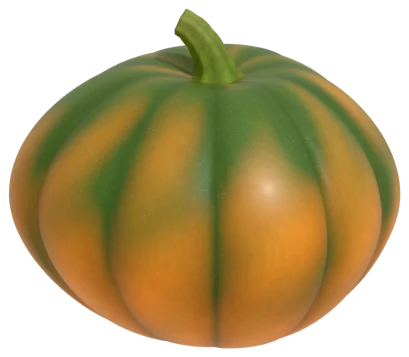
Not yet
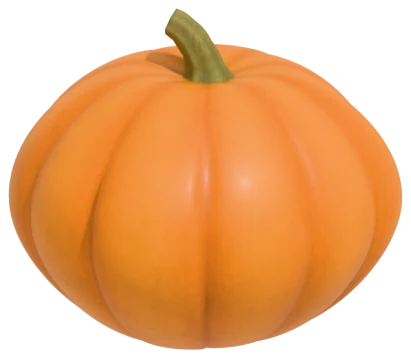
Ripe
| Temperature | Humidity | How long | |
|---|---|---|---|
| Cure | 80–85°F | about 80% | about 10 days |
| Store | 50–55°F | 50–70% | 2–3 months; chilling injury below 45°F |
Show giants are almost all selections of Atlantic Giant. They take 115–125 days, need about 150 sq ft per plant and carry a single fruit.

| Year | Grower | Weight |
|---|---|---|
| 2025 | Ian and Stuart Paton | 2,819.3 lb (1,278.8 kg) |
| 2023 | Travis Gienger | 2,749.0 lb (1,246.9 kg) |
| 2021 | Stefano Cutrupi | 2,702.9 lb (1,226.0 kg) |
| 2016 | Mathias Willemijns | 2,624.6 lb (1,190.5 kg) |
Stage days are typical for a carving pumpkin sown in warm soil; emergence (7–10 days) and fruit ripening (45–55 days after flowering) come from extension services, and the vining and first-flower days are approximate, counted back from them. Variety figures are from seed catalogues and extension tables. Records are as confirmed by the Great Pumpkin Commonwealth and Guinness World Records at the time of writing.