
Potato Growth Stages Chart
The five stages of a potato crop, above and below ground, from seed piece to set skin. See how long each stage lasts, date your own crop from planting to harvest, compare 14 varieties and catch problems at the stage they strike.
1.The five growth stages
University of Idaho potato specialists split the crop into five stages. Each one changes what the plant needs from you, and most of the action is underground, where you cannot see it. Choose a stage to see the cutaway and what to do.

IVTuber bulking
30–60 days or longer
Watch for: Colorado potato beetle; Aphids and viruses; Common scab; Hollow heart; Growth cracks and knobs; Late blight; Early blight; Wireworms; Greening.
Where is your crop now?
Day 60 of a mid-season crop: stage IV, tuber bulking, about 30 days to go in this stage. Water 1–1.5 in a week with no dry spells; watch for beetles and blight.
Spans are approximate, built from the University of Idaho stage lengths and Cornell’s maturity classes. A cold spring, a late planting or a heat wave stretches or squeezes every stage.
2.Planting to harvest, date by date
Enter your planting date and pick a variety or a maturity class. The dates below show when to expect each stage, when to hill and water hardest, and when to dig.
| Apr 20 | Plant into soil of 45°F or warmer, 3–4 in deep. |
| May 7 to May 21 | IShoots break the surface (2–5 weeks after planting). |
| May 26 | IIFirst hilling, once plants are 6–8 in tall; side-dress nitrogen. |
| Jun 1 to Jun 13 | IIITubers set. Second hilling about now; keep the soil evenly moist from here on. |
| Jun 1 to Jun 15 | New potatoes: dig a few from the side of a plant around flowering. |
| Jun 13 to Jul 19 | IVBulking: 1–1.5 in of water a week with no dry spells. |
| Jul 19 | VVines yellow and die back; cut back water. |
| Aug 2 to Aug 9 | Dig storage potatoes once the skin has set (2–3 weeks after the vines die). |
| Aug 9 to Aug 23 | Cure at 50–60°F and high humidity for 10–14 days, then store at 40–45°F. |
| Week | Stage | Water | Job |
|---|---|---|---|
| 1 · Apr 20 | I | none unless dry | Plant |
| 2 · Apr 27 | I | none unless dry | |
| 3 · May 4 | I | none unless dry | |
| 4 · May 11 | II | 1 in | |
| 5 · May 18 | II | 1 in | |
| 6 · May 25 | II | 1 in | First hilling |
| 7 · Jun 1 | III | 1 in | |
| 8 · Jun 8 | III | 1 in | Second hilling |
| 9 · Jun 15 | IV | 1–1.5 in | |
| 10 · Jun 22 | IV | 1–1.5 in | |
| 11 · Jun 29 | IV | 1–1.5 in | |
| 12 · Jul 6 | IV | 1–1.5 in | |
| 13 · Jul 13 | IV | 1–1.5 in | Vines yellow |
| 14 · Jul 20 | V | taper off | |
| 15 · Jul 27 | V | none | Check skin set |
| 16 · Aug 3 | V | none | Dig |
Water figures assume no rain: count rainfall toward the weekly amount. Water the soil, not the leaves, and early in the day.
3.Varieties by maturity
Early varieties give new potatoes soonest and dodge late-season pests; late ones yield and keep best but need a long season. Filter by class, skin colour or kitchen use.
14 of 14 varieties

Red NorlandEarly

Yukon GoldEarly

CaribeEarly

Russet NorkotahEarly

ChieftainEarly

Red PontiacMid-season

KennebecMid-season

All BlueMid-season

Purple MajestyMid-season

Yellow FinnMid-season

Princess LaRatteMid-season

Russet BurbankLate

German ButterballLate

CarolaLate
Days are Cornell’s variety bins (Vegetable Varieties for Gardeners); Arkansas gives 100 days for Red Pontiac and 110 for Kennebec. Pale bar ends show where sources differ. Tubers in the pictures share one scale.
4.Seed potatoes and planting
A potato crop starts from a piece of last year’s tuber, so the seed decides a lot: its health, its age and how it was cut. Plant in cool soil a few weeks before the last frost.
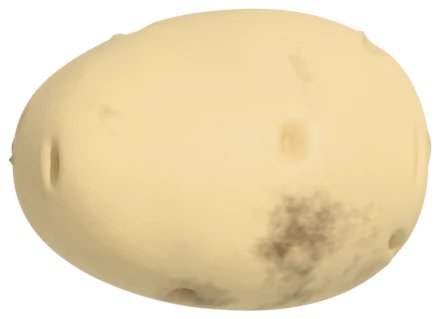
1.Buy certified seed
Grocery potatoes may carry disease or a sprout inhibitor.
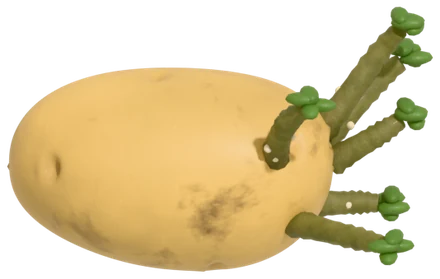
2.Green-sprout
2–6 weeks ahead, in a single layer, bright indirect light and 55–70°F: short, sturdy green sprouts under 1 in.

3.Cut big tubers
Pieces of 1.5–2 oz (a hen’s egg) with at least 1–2 eyes; plant egg-size seed whole.

4.Let cuts heal
A few days at 50–65°F with high humidity and air, until the cut face skins over.
| Soil | 45°F minimum; 50°F or warmer is faster |
|---|---|
| When | 2–4 weeks before the last spring frost |
| Depth | 3–4 in; up to 6 in in light soil |
| Spacing | 8–12 in apart, rows 30–36 in apart |
| Seed needed | 8–20 lb per 100 ft of row |
| Soil pH | 5.0–6.5; about 5.2 or lower holds back scab |
| Rotation | 3 years from any tomato-family crop |
Seed and harvest for your row
5.Hilling and water by stage
Tubers form on stolons that grow from the buried stem, above the seed piece. Hilling gives them room and keeps light off them; steady water from tuber set onward decides how many and how big.
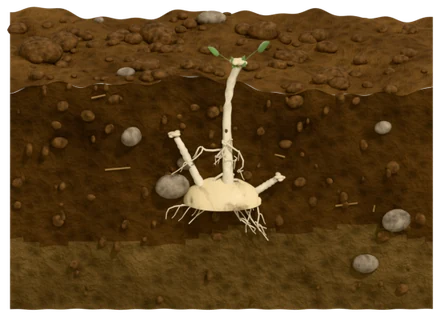
seed 3–4 in deep
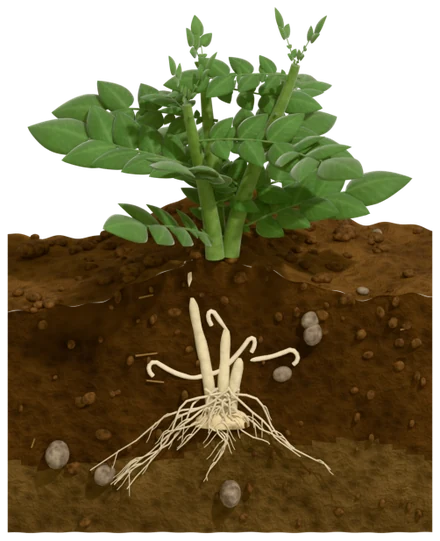
at 6–8 in tall
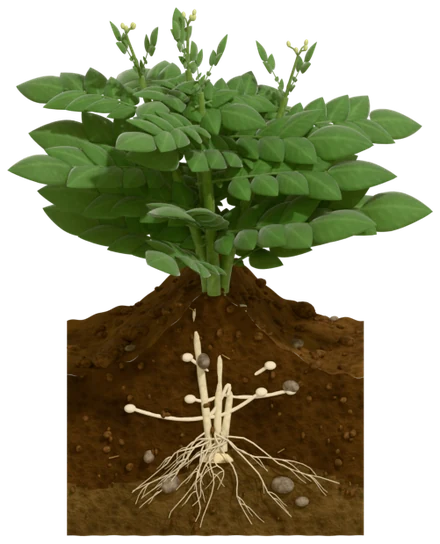
2–3 weeks later
Figure 3. The same row at planting, at the first hilling and at the second.
How to hill
- Draw loose soil up around the stems, leaving the top leaves showing.
- Repeat every 2–3 weeks; finish by bloom with a ridge 6–8 in high.
- Covered tubers stay white, and the stolons have room to set more.
- Or plant shallow and cover with 4–6 in of straw, adding more as it settles.
| ISprouting | Moist, not wet | Rain is usually enough. Soggy, cold soil rots seed pieces and slows emergence. |
|---|---|---|
| IIVegetative | About 1 in a week | Keep the soil at about 70–80% of what it can hold; a dry spell now holds back growth. |
| IIIInitiation | 1 in a week, steady | The stage most sensitive to drought. Dry soil while tubers set means fewer tubers and more scab. |
| IVBulking | 1–1.5 in a week | Peak water use. Dry spells cut yield for good; dry-then-soaked soil causes hollow heart, cracks and knobs. |
| VMaturation | Taper off | Cut back as the vines yellow and stop about a week before digging so the skins set; wet soil now invites rot. |
6.Harvest, curing and storage
Dig a few new potatoes while the plants flower, and leave the keepers until the vines have died and the skins have set. Cured, dark and cool, a late variety keeps for months.
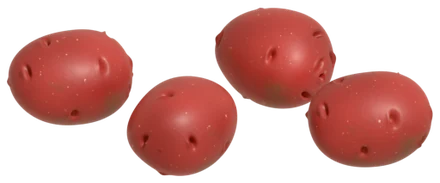
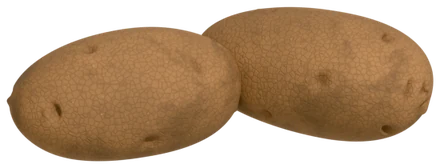
- New potatoes6–8 weeks after planting, around flowering. Use within about 10 days.
- Keeperswait until the vines die (or cut them), then 2–3 weeks more.
- Skin setrub a tuber with your thumb; the skin should not scrape off.
- Digon a dry day, forking 8–10 in from the stems. Brush, don’t wash.
CURE
50–60°F85–95% humidity10–14 days, darkSTORE
40–45°Fabout 90% humiditydark; 6–8 monthsBelow about 38–40°F starch turns to sugar; above 50°F tubers sprout sooner. Keep them away from apples and out of the light.

| A swollen stem | The tuber is the tip of a stolon packed with starch; the stem end is where it hung on the stolon. |
|---|---|
| Eyes are buds | Each sits above a leaf scar (the eyebrow), and they crowd toward the bud end, which sprouts first. |
| Lenticels | Are tiny breathing pores in the skin; they swell into white bumps in waterlogged soil. |
| Per 10 ft row | 10–20 lb, or about 1–2 lb a foot |
|---|---|
| Per plant | 2–5 lb |
| Tuber size | most 6–12 oz at harvest |
| Per person | 50 ft for fresh use, 50 ft more to store |
7.Problems at each stage
Most potato troubles belong to a stage: rot and cankers in cold spring soil, beetles on young plants, scab and hollow heart while tubers form, blight and greening late in the season. Choose a stage to see what to watch for then.

Seed piece decay
Seed pieces rot in the ground and leave gaps in the row.
What to do: Plant into well-drained soil of 45–50°F or warmer; heal cut seed; keep fertilizer 2 in from the seed.

Rhizoctonia and black scurf
Brown, sunken cankers on sprouts and stolons and a weak, patchy stand; hard black crusts on tubers that won’t wash off.
What to do: Don’t plant into cold (55–60°F), wet soil; plant shallow; use certified seed; rotate 3–4 years.

Colorado potato beetle
Striped yellow-and-black adults, orange egg clusters under leaves and humped brick-red larvae stripping the foliage.
What to do: Handpick adults and larvae and crush the eggs; row cover until mid-June; straw mulch; rotate. Flowering plants tolerate only 5–10% leaf loss.

Aphids and viruses
Mottled, rolled or crinkled leaves and stunted plants.
What to do: Plant certified seed every year instead of saving your own; control aphids.

Common scab
Rough, corky patches on the skin; the flesh is fine to eat once peeled.
What to do: Keep soil evenly moist for about 6 weeks from tuber set; soil pH near 5.2–5.5; resistant varieties; no fresh manure.

Hollow heart
A cavity, sometimes brown-walled, in the middle of large tubers.
What to do: Even moisture through initiation and bulking; don’t overwater early; even feeding.

Growth cracks and knobs
Healed splits, knobs, and dumbbell or pointed shapes.
What to do: Water evenly and mulch; no nitrogen late in the season.

Late blight
Water-soaked spots turn brown-black fast, with white growth beneath in damp weather; tubers get a firm brown rot.
What to do: Certified seed; keep leaves dry and water early; leave room for air. If it strikes, kill the vines and wait 2–3 weeks to dig.

Early blight
Brown spots with target-like rings on the older, lower leaves, then yellowing.
What to do: Keep plants fed and unstressed; water in the morning; clear away infected leaves and vines.

Wireworms
Holes the size of a pencil lead bored into the tubers.
What to do: Don’t plant right after lawn or sod; rotate the bed.

Greening
Green skin and flesh with a bitter taste (solanine).
What to do: Hill or mulch so no tuber sees light; store in the dark; cut away green parts.

Frost
Blackened leaves after a late frost (plants regrow); frozen tubers turn glassy and soft.
What to do: Plant 2–4 weeks before the last frost; cover young shoots; dig before hard freezes (tubers freeze near 30°F).
Sources and notes
Stage lengths come from the University of Idaho; dates, amounts and varieties from the extension services below. Days are typical for temperate home gardens and shift with variety, planting date, soil temperature and weather. Where sources disagree, the chart gives the range.
- University of Idaho Extension: BUL 789, Potato Irrigation Management (King and Stark), the five growth stages and their lengths; BUL 1114, Idaho Potatoes (2026)
- University of Maine Cooperative Extension: Bulletin #2077, Growing Potatoes in the Home Garden; Bulletin #2412, Selecting, Cutting and Handling Potato Seed
- University of Minnesota Extension: Growing potatoes in Minnesota home gardens (Tong); Crop planning deep dive: pondering potatoes (2026)
- Cornell Garden-Based Learning: Potatoes (home vegetable growing); Cornell Cooperative Extension, Vegetable Varieties for Gardeners (potato varieties)
- Penn State Extension: Potatoes in the Garden and the Kitchen (2026)
- Iowa State University Extension and Outreach: Growing Potatoes in the Home Garden (2024)
- University of Maryland Extension: Growing Potatoes in a Home Garden (2026)
- University of Illinois Extension: Potato, Home Vegetable Gardening
- Utah State University Extension: How to Grow Potatoes in Your Home Garden; Potato Seed Handling and Treatment; Varietal Selection
- University of Arkansas System Division of Agriculture: FSA6016, Irish Potatoes
- Kansas State University Research and Extension: MF488, Irish Potatoes (2020)
- South Dakota State University Extension: Potatoes, How to Grow It (2024)
- University of Alaska Fairbanks Cooperative Extension: HGA-00027, Growing Potatoes in the Alaska Garden
- University of Florida IFAS Extension: HS183, Growing Potatoes in the Florida Home Garden
- University of Nebraska-Lincoln CropWatch: Potatoes (production stages); Potato Defoliating Insects
- North Dakota State University and University of Minnesota: Potatoes 101; physiological disorders (Robinson)
- University of Wisconsin-Madison: Colorado Potato Beetle (vegetable entomology); Potato Scab, fact sheet D0083
- University of California Statewide IPM Program: Late Blight; Stem and Stolon Canker (Black Scurf)
- Texas A&M AgriLife Extension: EHT-068, Easy Gardening, Irish Potatoes
- University of New Hampshire Cooperative Extension: Growing Potatoes
- Colorado State University Extension (Grow and Give): potatoes in the Colorado vegetable handbook
- USDA Agricultural Research Service: Agriculture Handbook 66, Potato (storage and curing)