
Moon Planting Calendar Chart
The old almanac rule of sowing by the moon: leafy crops in the first quarter, fruiting crops in the second, roots in the third and rest in the fourth. With the real phase dates for 2026 and 2027, a crop lookup, and a plain account of what the evidence says.
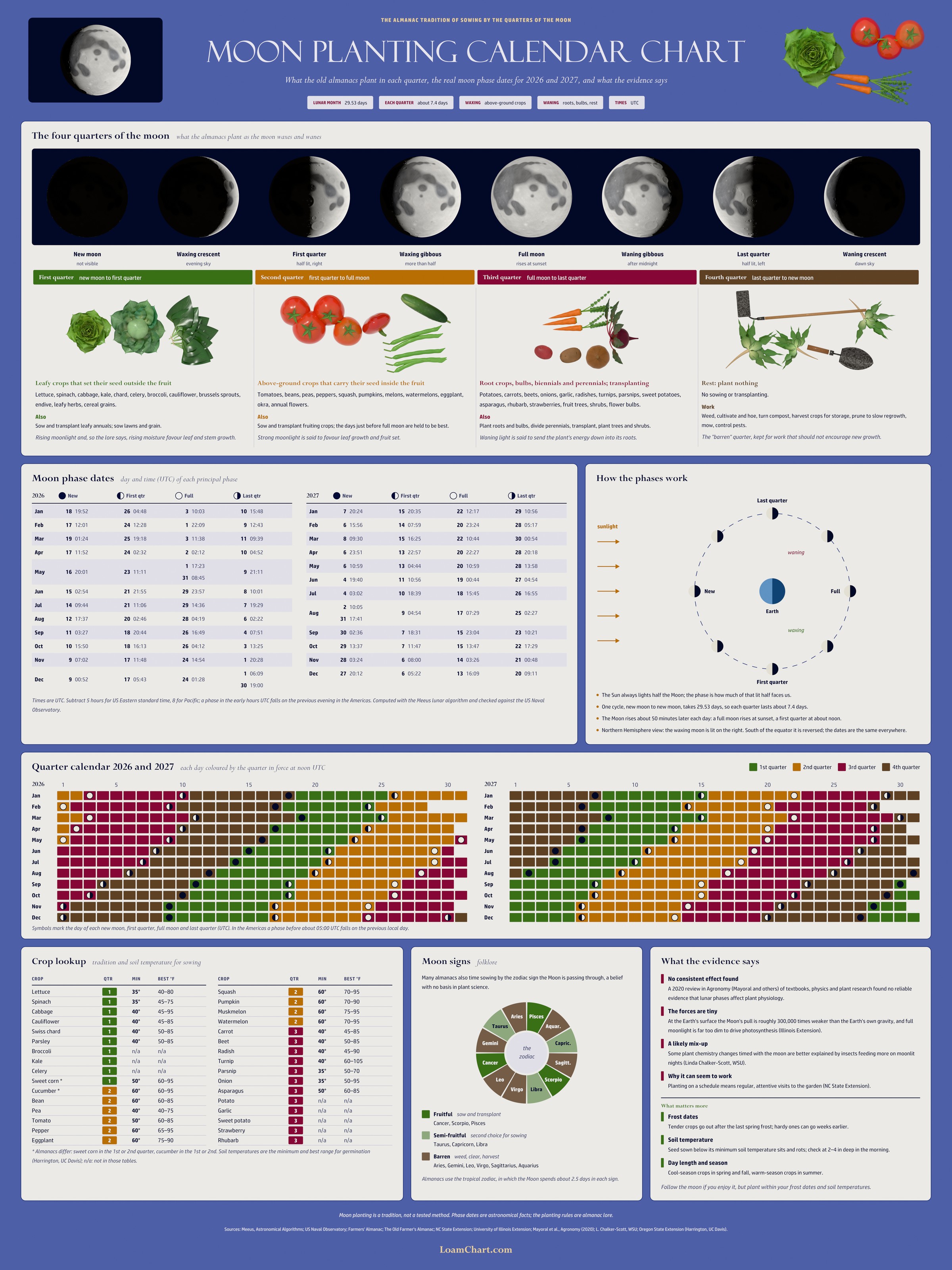
1.The moon on any date
Pick a date between July 2025 and June 2028. The phase, the quarter and what the almanac tradition says to do are worked out for noon UTC on that day, from computed phase times that match the US Naval Observatory to the minute.
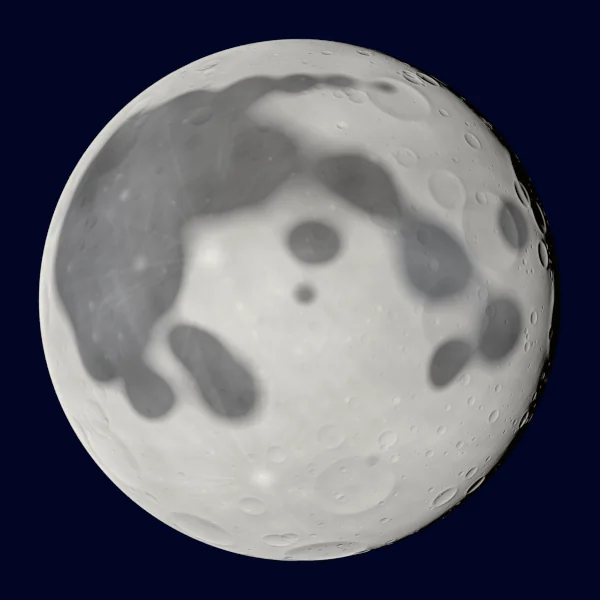
Waning gibbous
3rd quarter| Lit | 98% of the disc lit |
|---|---|
| Moon age | 16.8 days since the new moon |
| This quarter | Full moon Mon 26 Oct 04:12 to last quarter Sun 1 Nov 20:28 UTC |
| Next phases | Last quarter: Sun 1 Nov, 20:28 New moon: Mon 9 Nov, 07:02 First quarter: Tue 17 Nov, 11:48 Full moon: Tue 24 Nov, 14:54 |
| Moon sign | Taurus (semi-fruitful in almanac lore) |
Times are UTC. In the Americas a phase in the early hours UTC falls on the previous evening local time, so a quarter can start a day earlier where you are. The moon sign is the tropical zodiac sign used by almanacs, shown as folklore.
2.A month of phases and quarters
Each day is coloured by the quarter in force at noon UTC, and the four principal phases are marked with their time. Use the arrows or pick a month.
3.What the almanacs plant in each quarter
The rule divides the 29.5-day lunar month into four quarters of about a week. While the moon waxes from new to full, the almanacs sow crops that bear above ground; while it wanes, they plant roots and bulbs, and in the last week they plant nothing.
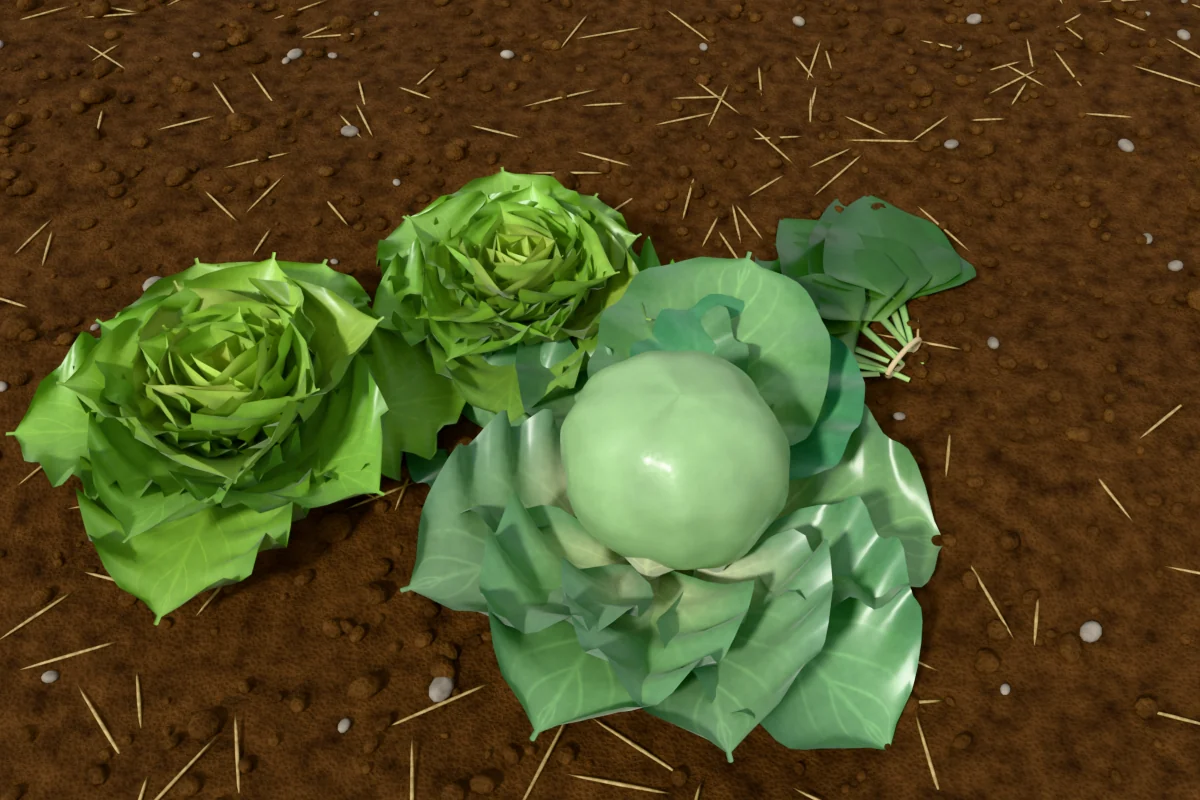
New moon to first quarter: waxing crescent
Leafy crops that set their seed outside the fruit.
- CROPS
- Lettuce, spinach, cabbage, kale, chard, celery, broccoli, cauliflower, Brussels sprouts, endive, leafy herbs, cereal grains.
- ALSO
- Sow and transplant leafy annuals; sow lawns and grain.
Rising moonlight and, so the lore says, rising moisture favour leaf and stem growth.
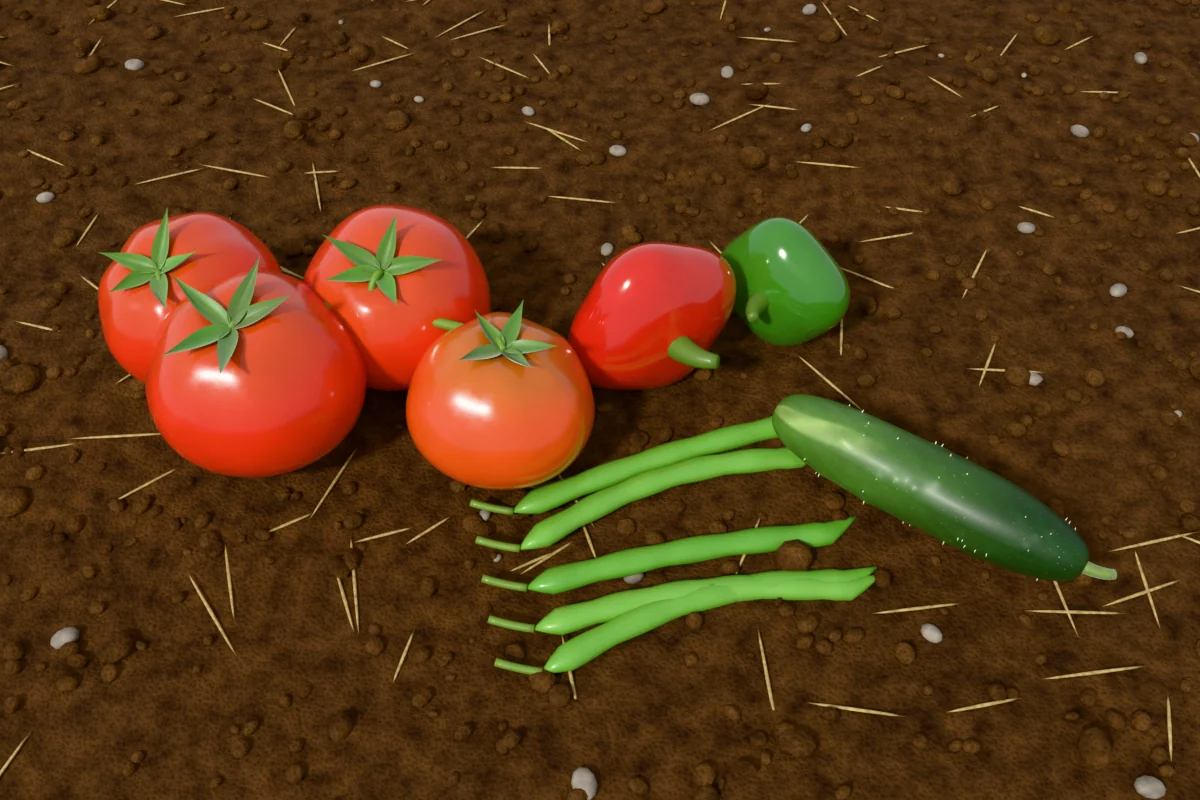
First quarter to full moon: waxing gibbous
Above-ground crops that carry their seed inside the fruit.
- CROPS
- Tomatoes, beans, peas, peppers, squash, pumpkins, melons, watermelons, eggplant, okra, annual flowers.
- ALSO
- Sow and transplant fruiting crops; the days just before full moon are held to be best.
Strong moonlight is said to favour leaf growth and fruit set.
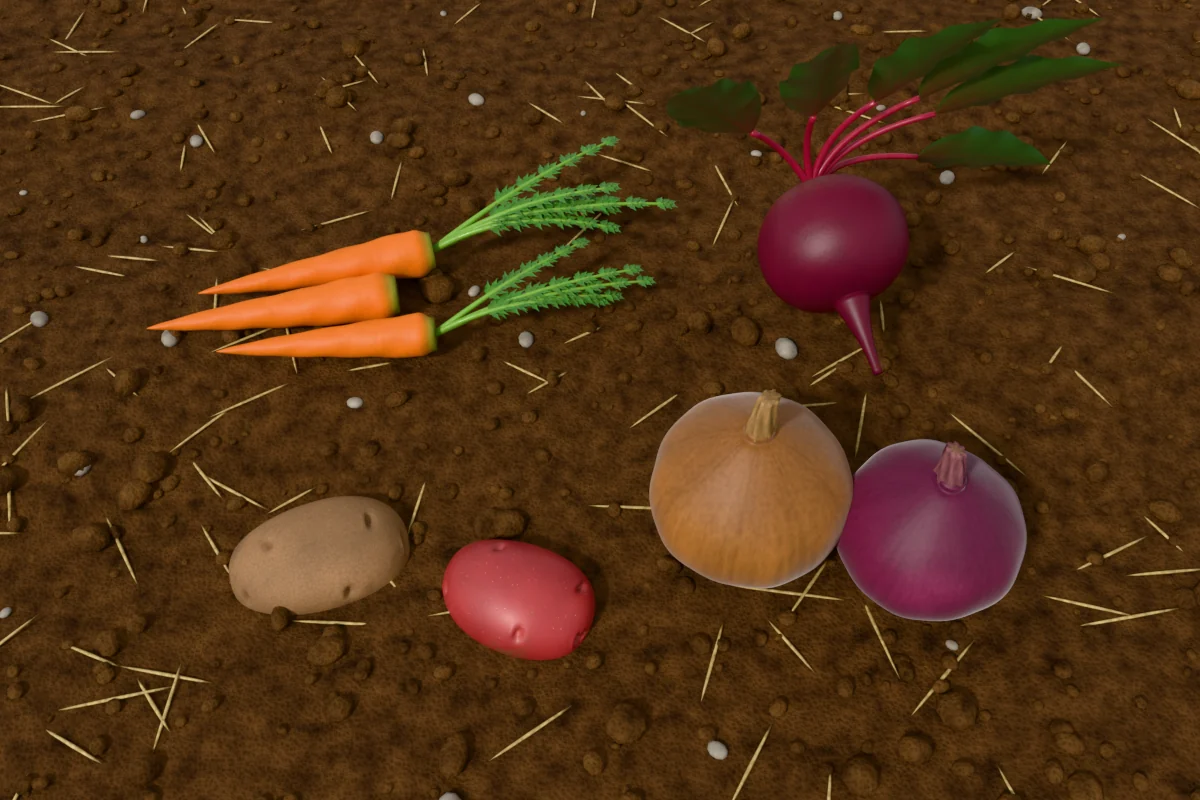
Full moon to last quarter: waning gibbous
Root crops, bulbs, biennials and perennials; transplanting.
- CROPS
- Potatoes, carrots, beets, onions, garlic, radishes, turnips, parsnips, sweet potatoes, asparagus, rhubarb, strawberries, fruit trees, shrubs, flower bulbs.
- ALSO
- Plant roots and bulbs, divide perennials, transplant, plant trees and shrubs.
Waning light is said to send the plant's energy down into its roots.
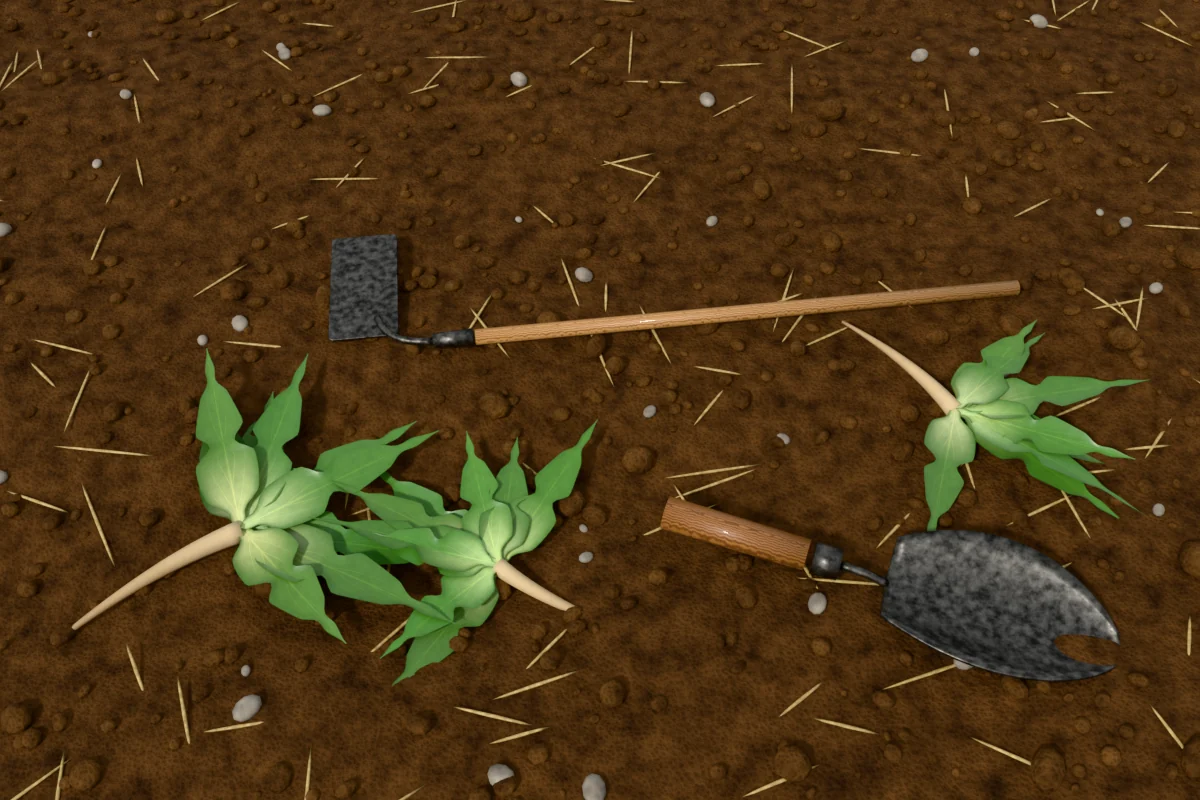
Last quarter to new moon: waning crescent
Rest: plant nothing.
- SOWING
- None. No sowing or transplanting.
- WORK
- Weed, cultivate and hoe, turn compost, harvest crops for storage, prune to slow regrowth, mow, control pests.
The "barren" quarter, kept for work that should not encourage new growth.
4.Which quarter for which crop
Choose a crop to see its quarter, the soil temperature its seed needs, and the next windows of that quarter after the date picked in section 1. Soil temperatures are the minimum and the best range for germination from J. F. Harrington's University of California tables.
| Mon 9 Nov 07:02 | to Tue 17 Nov 11:48 |
| Wed 9 Dec 00:52 | to Thu 17 Dec 05:43 |
| Thu 7 Jan 20:24 | to Fri 15 Jan 20:35 |
Windows run from one principal phase to the next, in UTC dates. Check the soil temperature and your frost dates before you sow.
| Crop | Quarter | Min °F | Best °F |
|---|---|---|---|
| Lettuce | 1st quarter | 35° | 40–80 |
| Spinach | 1st quarter | 35° | 45–75 |
| Cabbage | 1st quarter | 40° | 45–95 |
| Cauliflower | 1st quarter | 40° | 45–85 |
| Swiss chard | 1st quarter | 40° | 50–85 |
| Parsley | 1st quarter | 40° | 50–85 |
| Broccoli | 1st quarter | n/a | n/a |
| Kale | 1st quarter | n/a | n/a |
| Celery | 1st quarter | n/a | n/a |
| Sweet corn * | 1st quarter | 50° | 60–95 |
| Cucumber * | 2nd quarter | 60° | 60–95 |
| Bean | 2nd quarter | 60° | 60–85 |
| Pea | 2nd quarter | 40° | 40–75 |
| Tomato | 2nd quarter | 50° | 60–85 |
| Pepper | 2nd quarter | 60° | 65–95 |
| Eggplant | 2nd quarter | 60° | 75–90 |
| Squash | 2nd quarter | 60° | 70–95 |
| Pumpkin | 2nd quarter | 60° | 70–90 |
| Muskmelon | 2nd quarter | 60° | 75–95 |
| Watermelon | 2nd quarter | 60° | 70–95 |
| Carrot | 3rd quarter | 40° | 45–85 |
| Beet | 3rd quarter | 40° | 50–85 |
| Radish | 3rd quarter | 40° | 45–90 |
| Turnip | 3rd quarter | 40° | 60–105 |
| Parsnip | 3rd quarter | 35° | 50–70 |
| Onion | 3rd quarter | 35° | 50–95 |
| Asparagus | 3rd quarter | 50° | 60–85 |
| Potato | 3rd quarter | n/a | n/a |
| Garlic | 3rd quarter | n/a | n/a |
| Sweet potato | 3rd quarter | n/a | n/a |
| Strawberry | 3rd quarter | n/a | n/a |
| Rhubarb | 3rd quarter | n/a | n/a |
5.How the phases work
The Sun always lights half of the Moon. As the Moon circles the Earth, we see more or less of that lit half: none at new moon, half at the quarters, all of it at full moon. The cycle from new moon to new moon takes 29.53 days.
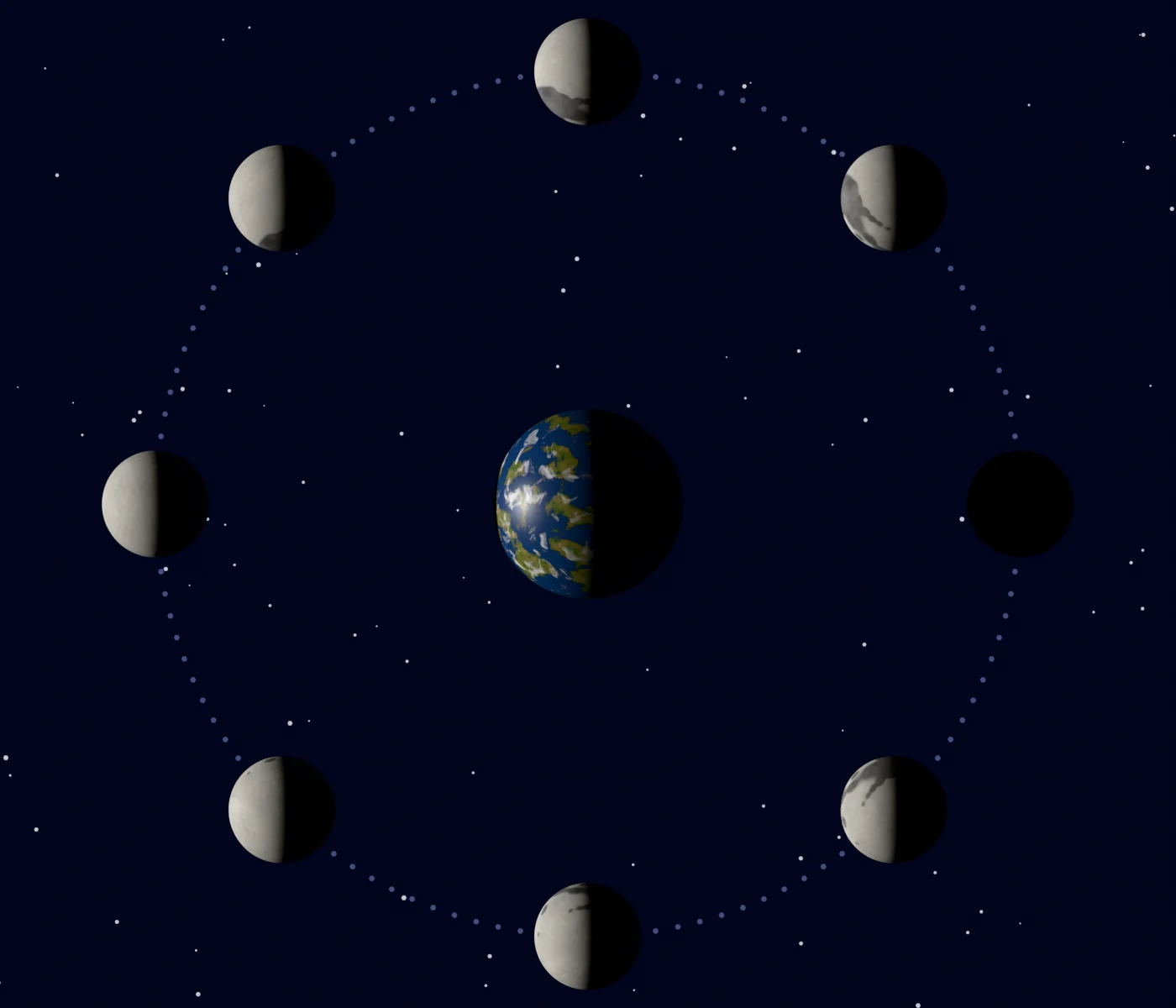
Through one cycle

| Phase | Days after new | Rises |
|---|---|---|
| New moon | 0 | with the Sun, not visible |
| First quarter | about 7.4 | around noon, seen in the evening |
| Full moon | about 14.8 | at sunset, up all night |
| Last quarter | about 22.1 | around midnight, seen at dawn |
6.The moon signs are folklore
Many almanacs add a second layer: the zodiac sign the Moon is passing through. The "fruitful" water signs are held to be best for sowing and the "barren" signs for weeding and harvest. The Moon moves through each sign in about two and a half days. There is no evidence for any of it; it is shown here because almanac calendars use it.
| Class | Signs | Used for |
|---|---|---|
| Fruitful | Cancer, Scorpio, Pisces | sowing and transplanting |
| Semi-fruitful | Taurus, Capricorn, Libra | sowing, second choice |
| Barren | Aries, Gemini, Leo, Virgo, Sagittarius, Aquarius | weeding, clearing, harvest for storage |
Fruitful days ahead
The 14 days from Tue 27 Oct 2026, with the moon sign at noon UTC.
| Tue 27 Oct | Taurus | semi-fruitful | 3rd quarter |
| Wed 28 Oct | Gemini | barren | 3rd quarter |
| Thu 29 Oct | Gemini | barren | 3rd quarter |
| Fri 30 Oct | Cancer | fruitful | 3rd quarter |
| Sat 31 Oct | Cancer | fruitful | 3rd quarter |
| Sun 1 Nov | Leo | barren | 3rd quarter |
| Mon 2 Nov | Leo | barren | 4th quarter |
| Tue 3 Nov | Virgo | barren | 4th quarter |
| Wed 4 Nov | Virgo | barren | 4th quarter |
| Thu 5 Nov | Virgo | barren | 4th quarter |
| Fri 6 Nov | Libra | semi-fruitful | 4th quarter |
| Sat 7 Nov | Libra | semi-fruitful | 4th quarter |
| Sun 8 Nov | Scorpio | fruitful | 4th quarter |
| Mon 9 Nov | Scorpio | fruitful | 1st quarter |
7.What the evidence says
Extension specialists are clear that there is no scientific evidence that the moon's phase changes how crops grow. Many gardeners still enjoy the calendar as a planting rhythm. If you follow it, follow it inside the limits that do matter: frost dates, soil temperature and the season.
A 2020 review in Agronomy (Mayoral and others) of textbooks, physics and plant research found no reliable evidence that lunar phases affect plant physiology.
At the Earth's surface the Moon's pull is roughly 300,000 times weaker than the Earth's own gravity, and full moonlight is far too dim to drive photosynthesis (Illinois Extension).
Some plant chemistry changes timed with the moon are better explained by insects feeding more on moonlit nights (Linda Chalker-Scott, WSU).
Planting on a schedule means regular, attentive visits to the garden (NC State Extension).
Three things decide whether seed comes up and plants thrive, whatever the moon is doing.
Tender crops go out after the last spring frost; hardy ones can go weeks earlier.
Seed sown below its minimum soil temperature sits and rots; check at 2–4 in deep in the morning.
Cool-season crops in spring and fall, warm-season crops in summer.
Sources and notes
Phase times were computed with the lunar phase algorithm in Jean Meeus's Astronomical Algorithms (chapter 49) and agree with the US Naval Observatory's published phases for 2026 and 2027 to within a minute. Moon signs use the Moon's tropical ecliptic longitude (Meeus, chapter 47), which agrees with NASA JPL Horizons to a few hundredths of a degree. The planting rules are the almanac tradition as described by the Farmers' Almanac and The Old Farmer's Almanac; almanacs differ in details.
- Jean Meeus: Astronomical Algorithms, 2nd ed. (1998), ch. 47 and 49
- US Naval Observatory: Phases of the Moon, 2026 and 2027
- Farmers' Almanac: Why Do We Garden By The Moon?
- The Old Farmer's Almanac: Planting by the Moon's Phase
- N.C. Cooperative Extension, Henderson County (S. Pettis, 2025): Gardening by Signs: Superstition or Wisdom?
- University of Illinois Extension (R. Pankau, 2022): Lunar influence on gardening
- O. Mayoral, J. Solbes, J. Cantó, T. Pina (2020): What Has Been Thought and Taught on the Lunar Influence on Plants in Agriculture? Agronomy 10(7): 955
- Linda Chalker-Scott, Washington State University (The Garden Professors, 2010): Lunar control? Or lunacy?
- Oregon State University Extension (data: J. F. Harrington, UC Davis): Soil temperature conditions for vegetable seed germination