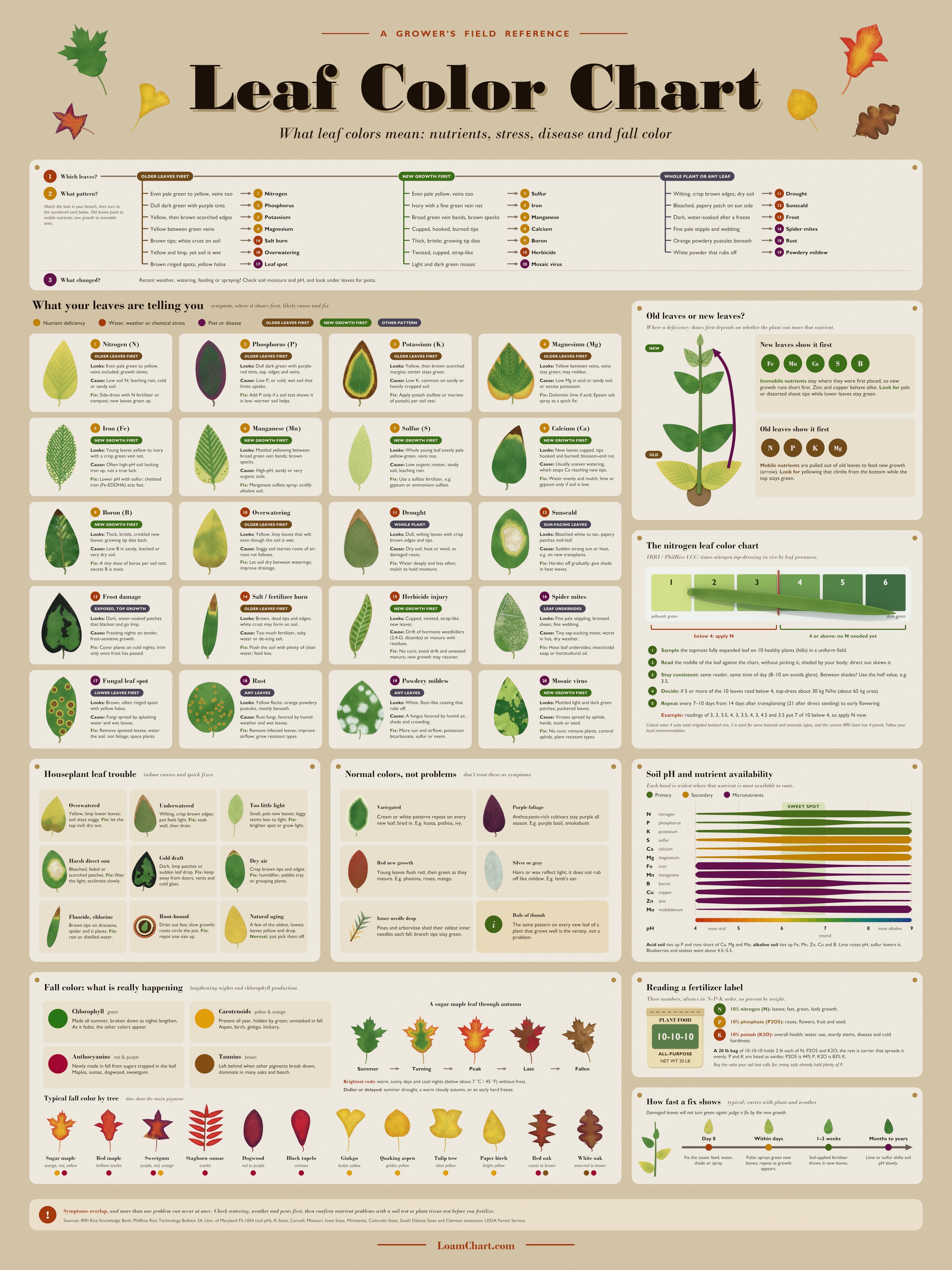
Yellow, purple, scorched or speckled leaves on one chart: 20 symptoms with their cause and fix, 12 nutrients across soil pH 4 to 9, the six shades of the rice nitrogen chart, houseplant problems, normal colors and 12 trees in fall color.
Figure 1. The Leaf Color Chart: a diagnosis flowchart, 20 leaf symptom cards, soil pH nutrient bands, the rice leaf color chart, a fertilizer label, houseplant problems and fall leaf colors.
The same flowchart as the printed chart. Where a symptom shows first narrows the cause before you look at the pattern itself.
1Which leaves?
2What pattern?
3Likely cause
Where did the change show up first?
Check the lowest, oldest leaves against the youngest leaves at the shoot tips.
What does it look like?
2.Twenty leaf symptoms side by side
Every symptom card from the chart: what it looks like, where it shows first, the usual cause and the fix. Filter by kind of problem or by which leaves it hits.
Showing 20 of 20 symptoms
1
Nitrogen (N)
Older leaves first
Looks
Even pale green to yellow, veins included; growth slows.
Cause
Low soil N; leaching rain, cold or sandy soil.
Fix
Side-dress with N fertilizer or compost; new leaves green up.
2
Phosphorus (P)
Older leaves first
Looks
Dull dark green with purple-red tints, esp. edges and veins.
Cause
Low P, or cold, wet soil that limits uptake.
Fix
Add P only if a soil test shows it is low; warmer soil helps.
3
Potassium (K)
Older leaves first
Looks
Yellow, then brown scorched margins; center stays green.
Cause
Low K, common on sandy or heavily cropped soil.
Fix
Apply potash (sulfate or muriate of potash) per soil test.
4
Magnesium (Mg)
Older leaves first
Looks
Yellow between veins, veins stay green; may redden.
Cause
Low Mg in acid or sandy soil, or excess potassium.
Fix
Dolomitic lime if acid; Epsom salt spray as a quick fix.
5
Iron (Fe)
New growth first
Looks
Young leaves yellow to ivory with a crisp green vein net.
Cause
Often high-pH soil locking iron up, not a true lack.
Fix
Lower pH with sulfur; chelated iron (Fe-EDDHA) acts fast.
6
Manganese (Mn)
New growth first
Looks
Mottled yellowing between broad green vein bands; brown specks.
Cause
High-pH, sandy or very organic soils.
Fix
Manganese sulfate spray; acidify alkaline soil.
7
Sulfur (S)
New growth first
Looks
Whole young leaf evenly pale yellow-green, veins too.
Cause
Low organic matter, sandy soil, leaching rain.
Fix
Use a sulfate fertilizer, e.g. gypsum or ammonium sulfate.
8
Calcium (Ca)
New growth first
Looks
New leaves cupped, tips hooked and burned; blossom-end rot.
Cause
Usually uneven watering, which stops Ca reaching new tips.
Fix
Water evenly and mulch; lime or gypsum only if soil is low.
9
Boron (B)
New growth first
Looks
Thick, brittle, crinkled new leaves; growing tip dies back.
Cause
Low B in sandy, leached or very dry soil.
Fix
A tiny dose of borax per soil test; excess B is toxic.
10
Overwatering
Older leaves first
Looks
Yellow, limp leaves that wilt even though the soil is wet.
Cause
Soggy soil starves roots of air; root rot follows.
Fix
Let soil dry between waterings; improve drainage.
11
Drought
Whole plant
Looks
Dull, wilting leaves with crisp brown edges and tips.
Cause
Dry soil, heat or wind, or damaged roots.
Fix
Water deeply and less often; mulch to hold moisture.
12
Sunscald
Sun-facing leaves
Looks
Bleached white to tan, papery patches mid-leaf.
Cause
Sudden strong sun or heat, e.g. on new transplants.
Fix
Harden off gradually; give shade in heat waves.
13
Frost damage
Exposed, top growth
Looks
Dark, water-soaked patches that blacken and go limp.
Cause
Freezing nights on tender, frost-sensitive growth.
Fix
Cover plants on cold nights; trim only once frost has passed.
14
Salt / fertilizer burn
Older leaves first
Looks
Brown, dead tips and edges; white crust may form on soil.
Cause
Too much fertilizer, salty water or de-icing salt.
Fix
Flush the soil with plenty of clean water; feed less.
15
Herbicide injury
New growth first
Looks
Cupped, twisted, strap-like new leaves.
Cause
Drift of hormone weedkillers (2,4-D, dicamba) or manure with residues.
Fix
No cure; avoid drift and untested manure; new growth may recover.
16
Spider mites
Leaf undersides
Looks
Fine pale stippling, bronzed sheen, fine webbing.
Cause
Tiny sap-sucking mites; worst in hot, dry weather.
Fix
Hose leaf undersides; insecticidal soap or horticultural oil.
17
Fungal leaf spot
Lower leaves first
Looks
Brown, often ringed spots with yellow halos.
Cause
Fungi spread by splashing water and wet leaves.
Fix
Remove spotted leaves; water the soil, not foliage; space plants.
A fungus favored by humid air, shade and crowding.
Fix
More sun and airflow; potassium bicarbonate, sulfur or neem.
20
Mosaic virus
New growth first
Looks
Mottled light and dark green patches; puckered leaves.
Cause
Viruses spread by aphids, hands, tools or seed.
Fix
No cure: remove plants, control aphids, plant resistant types.
No symptoms match. Try another word or clear a filter.
3.Old leaves and new leaves
Where a deficiency shows first depends on whether the plant can move that nutrient. Tap a nutrient to see its symptom.
NewOld
Figure 2. Nitrogen moves from old leaves to new growth; iron stays put.
New leaves show it first
Immobile nutrients stay where they were first placed, so new growth runs short first. Zinc and copper behave alike. Look for pale or distorted shoot tips while lower leaves stay green.
Old leaves show it first
Mobile nutrients are pulled out of old leaves to feed new growth (the arrow). Look for yellowing that climbs from the bottom while the top stays green.
Nitrogen (N)
Even pale green to yellow, veins included; growth slows.
The soil can hold a nutrient and still starve the plant. Each band is widest where that nutrient is most available to roots. Slide the pH to see what is plentiful and what gets tied up.
Figure 3. Relative availability of 12 nutrients from pH 4 to 9. The pin marks the pH you choose.
At pH 6.5, no nutrient is badly tied up; iron, manganese and molybdenum are less available.
The sweet spot for most garden plants: nearly everything is within reach.
5.Timing nitrogen with a leaf color chart
The IRRI / PhilRice leaf color chart (LCC) times nitrogen top-dressing in rice by how green the leaves are. Pick a shade, tap a leaf to record each reading, and the chart’s rule gives the call.
yellowish greencritical value 4dark green
Figure 4. The six-panel rice leaf color chart, shade 1 (yellowish green) to shade 6 (dark green).
1 · Pick a shade (half values for in-between)
2 · Tap each of 10 leaves to record it
0 of 10 leaves readRead the topmost fully expanded leaf on 10 healthy plants.
Sample the topmost fully expanded leaf on 10 healthy plants (hills) in a uniform field.
Read the middle of the leaf against the chart, without picking it, shaded by your body; direct sun skews it.
Stay consistent: same reader, same time of day (8–10 am avoids glare). Between shades? Use the half value, e.g. 3.5.
Decide: if 5 or more of the 10 leaves read below 4, top-dress about 30 kg N/ha (about 65 kg urea).
Repeat every 7–10 days from 14 days after transplanting (21 after direct seeding) to early flowering.
Critical value 4 suits most irrigated lowland rice; 3 is used for some basmati and aromatic types, and the current IRRI chart has 4 panels. Follow your local recommendation.
6.Reading a fertilizer label
Three numbers, always in N-P-K order, as percent by weight. Enter any label to see how much nitrogen, phosphate and potash you are actually buying.
Figure 5. A 20 lb bag of 10-10-10 holds 2 lb each of N, P2O5 and K2O.
What the bag holds
Nitrogen (N)
2 lb
leafy green growth
Phosphate (P2O5)
2 lb
= 0.87 lb of elemental P
Potash (K2O)
2 lb
= 1.66 lb of elemental K
NP2O5K2Ocarrier and other ingredients
How much of this product?
To applylbof
You need 10 lb of this 10-10-10 product, about 50% of the bag.
A common lawn rate is about 1 lb of N per 1,000 sq ft per feeding; garden rates vary. Buy the ratio your soil test calls for; many soils already hold plenty of P.
10% phosphate (P2O5): roots, flowers, fruit and seed.
K
10% potash (K2O): overall health; water use, sturdy stems, disease and cold hardiness.
P and K are listed as oxides: P2O5 is 44% P, K2O is 83% K. The rest of the bag is carrier that spreads the nutrients evenly.
How fast a fix shows
Typical; varies with plant and weather. Damaged leaves will not turn green again: judge a fix by the new growth.
Day 0Fix the cause: feed, water, shade or spray.
Within daysFoliar sprays green new leaves; repeat as growth appears.
1–3 weeksSoil-applied fertilizer shows in new leaves.
Months to yearsLime or sulfur shifts soil pH slowly.
7.Houseplant leaf trouble
Indoor plants rarely run short of nutrients first. Light, water, air and the pot cause most problems. Tick what you see to rank the likely causes.
Pick one or more clues above.
OverwateredBest match
Yellow, limp lower leaves; soil stays soggy. Fix: let the top inch dry out.
UnderwateredBest match
Wilting, crisp brown edges; pot feels light. Fix: soak well, then drain.
Too little lightBest match
Small, pale new leaves; leggy stems lean to light. Fix: brighter spot or grow light.
Harsh direct sunBest match
Bleached, faded or scorched patches. Fix: filter the light; acclimate slowly.
Cold draftBest match
Dark, limp patches or sudden leaf drop. Fix: keep away from doors, vents and cold glass.
Dry airBest match
Crisp brown tips and edges. Fix: humidifier, pebble tray or grouping plants.
Fluoride, chlorineBest match
Brown tips on dracaena, spider and ti plants. Fix: rain or distilled water.
Root-boundBest match
Dries out fast; slow growth; roots circle the pot. Fix: repot one size up.
Natural agingBest match
A few of the oldest, lowest leaves yellow and drop. Normal: just pick them off.
8.Normal colors, not problems
Some odd colors are bred in or seasonal. If every new leaf shows the same pattern and the plant grows well, leave it alone.
Variegated
Cream or white patterns repeat on every new leaf; bred in. E.g. hosta, pothos, ivy.
Purple foliage
Anthocyanin-rich cultivars stay purple all season. E.g. purple basil, smokebush.
Red new growth
Young leaves flush red, then green as they mature. E.g. photinia, roses, mango.
Silver or gray
Hairs or wax reflect light; it does not rub off like mildew. E.g. lamb’s ear.
Inner needle drop
Pines and arborvitae shed their oldest inner needles each fall; branch tips stay green.
i
Rule of thumb
The same pattern on every new leaf of a plant that grows well is the variety, not a problem.
9.What happens to leaves in autumn
Lengthening nights end chlorophyll production. Drag through one sugar maple leaf’s autumn and watch which pigments are left in charge.
Figure 6. One sugar maple leaf from summer green to fallen brown.
Stage 1 of 5Summer
The leaf makes chlorophyll all season, breaking it down and replacing it. The green masks yellow carotenoids that are there all along.
SummerTurningPeakLateFallen
Chlorophyll
Carotenoids
Anthocyanins
Tannins
Pigment levels are illustrative, not measured.
Chlorophyllgreen
Made all summer, broken down as nights lengthen. As it fades, the other colors appear.
Carotenoidsyellow & orange
Present all year, hidden by green; unmasked in fall. Aspen, birch, ginkgo, hickory.
Anthocyaninsred & purple
Newly made in fall from sugars trapped in the leaf. Maples, sumac, dogwood, sweetgum.
Tanninsbrown
Left behind when other pigments break down; dominate in many oaks and beech.
Brightest reds: warm, sunny days and cool nights (below about 7 °C / 45 °F) without frost.
Duller or delayed: summer drought, a warm cloudy autumn, or an early hard freeze.
Typical fall color by tree
Dots show the main pigment. Filter by pigment.
Sugar maple
orange, red, yellow
main pigments: carotenoids, anthocyanins
Red maple
brilliant scarlet
main pigments: anthocyanins
Sweetgum
purple, red, orange
main pigments: anthocyanins, carotenoids
Staghorn sumac
scarlet
main pigments: anthocyanins
Dogwood
red to purple
main pigments: anthocyanins
Black tupelo
crimson
main pigments: anthocyanins
Ginkgo
butter yellow
main pigments: carotenoids
Quaking aspen
golden yellow
main pigments: carotenoids
Tulip tree
clear yellow
main pigments: carotenoids
Paper birch
bright yellow
main pigments: carotenoids
Red oak
russet to brown
main pigments: anthocyanins, tannins
White oak
wine-red to brown
main pigments: tannins, anthocyanins
Sources and notes
Symptoms overlap, and more than one problem can occur at once. Check watering, weather and pests first, then confirm nutrient problems with a soil test or plant tissue test before you fertilize.
Availability bands are relative and drawn after the classic soil-pH chart; actual levels depend on the soil. Houseplant and normal-color notes are general advice.
IRRI Rice Knowledge Bank
PhilRice Rice Technology Bulletin 24
University of Maryland FS-1054 (soil pH)
K-State, Cornell, Missouri, Iowa State, Minnesota, Colorado State, South Dakota State and Clemson extension

 LoamChart