
Lawn Fertilizer Schedule Chart
A lawn needs nitrogen at the right season and in the right dose more than it needs any particular product. This chart gives the month-by-month nitrogen schedule for four cool-season and five warm-season grasses, how much each needs in a year and at one feeding, how to turn the three numbers on a bag into pounds of product, and how to spread it, water it in and decide when lime or phosphorus is worth adding.
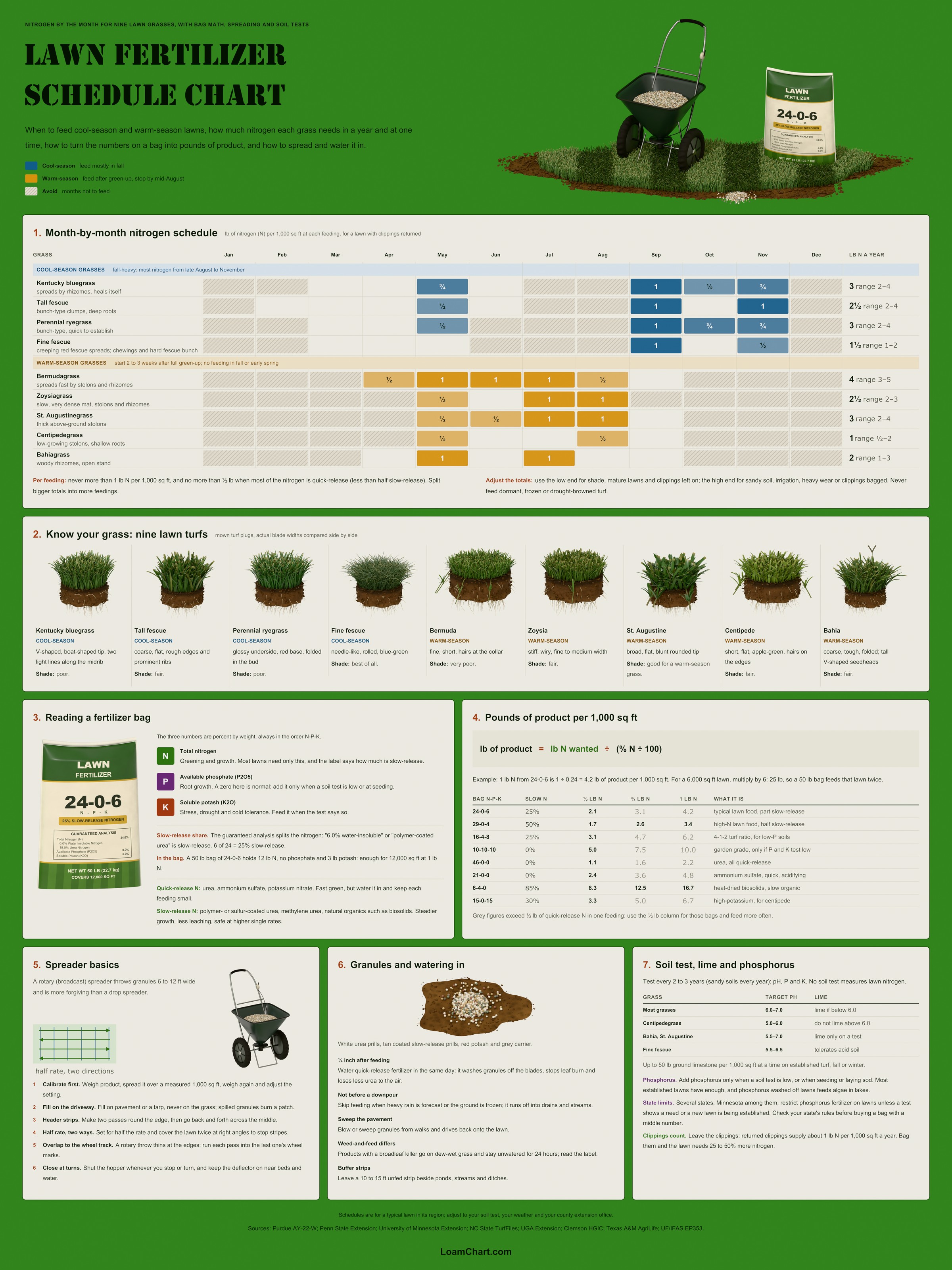
Contents
1.Cool-season or warm-season grass by region
Every schedule on this page starts with one question: does your grass grow in the cool months or the warm ones? Cool-season grasses (Kentucky bluegrass, the fescues, perennial ryegrass) grow hardest in spring and fall and are fed mostly in fall. Warm-season grasses (bermuda, zoysia, St. Augustine, centipede, bahia) grow in summer heat and are fed only after they green up. Pick your region and how much sun the lawn gets to see the grasses that suit it.
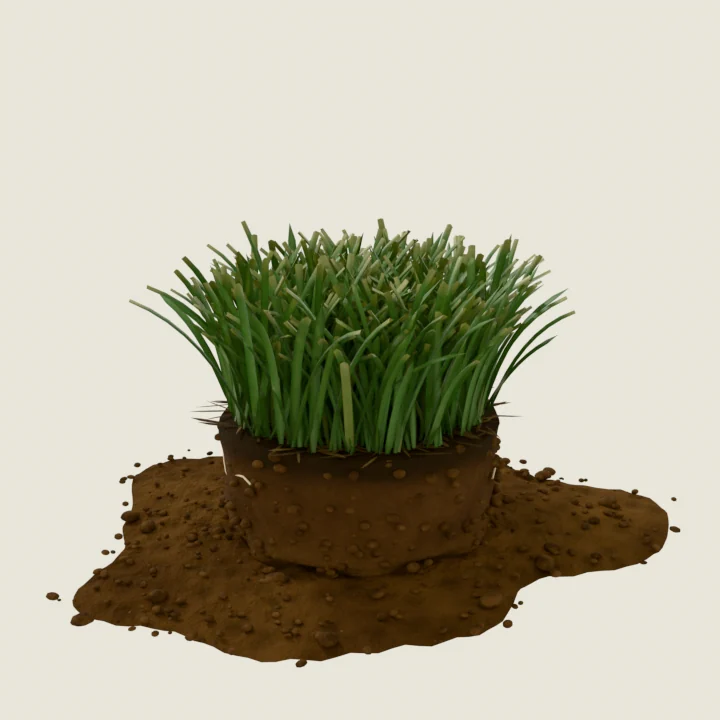
V-shaped, boat-shaped tip, two light lines along the midrib; spreads by rhizomes, heals itself.
2–4 lb N a year · shade: poor · drought: goes dormant, recovers
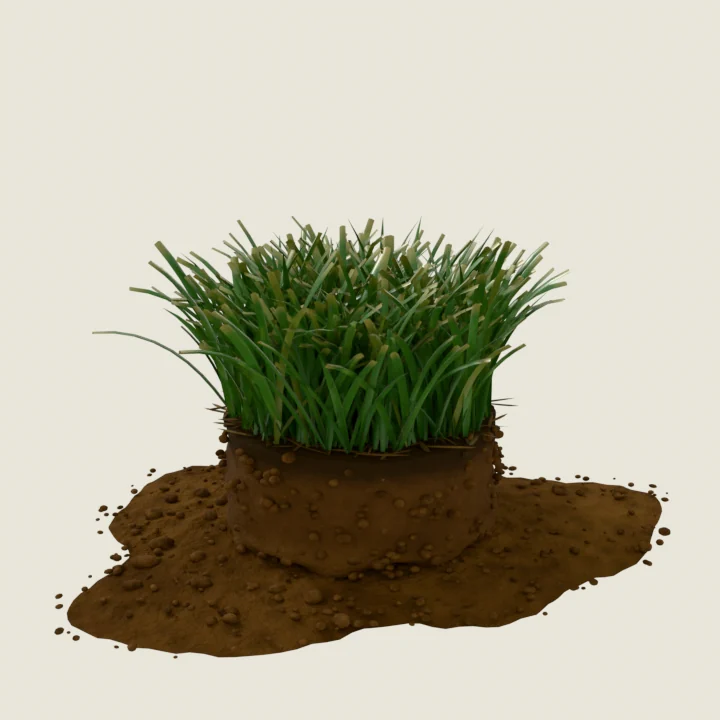
Glossy underside, red base, folded in the bud; bunch-type, quick to establish.
2–4 lb N a year · shade: poor · drought: fair
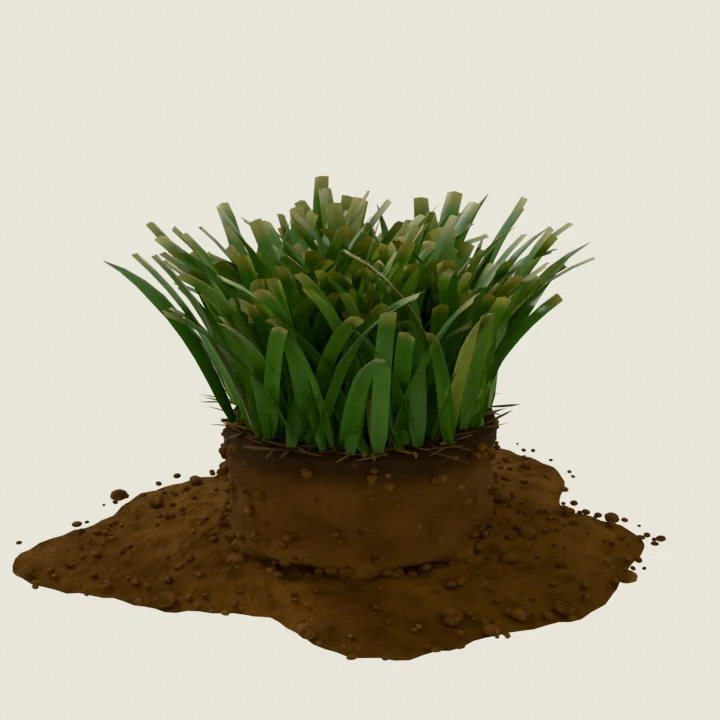
Coarse, flat, rough edges and prominent ribs; bunch-type clumps, deep roots.
2–4 lb N a year · shade: fair · drought: good, deep roots
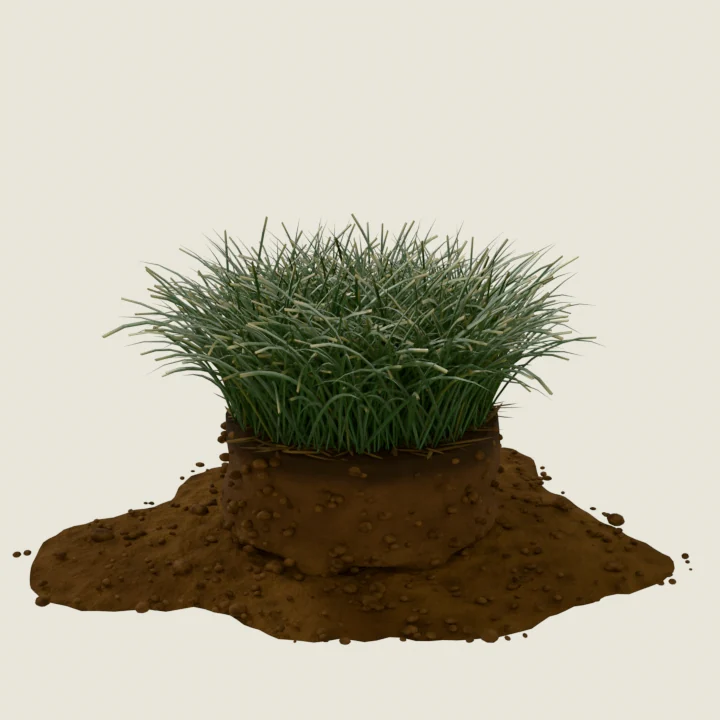
Needle-like, rolled, blue-green; creeping red fescue spreads; chewings and hard fescue bunch.
1–2 lb N a year · shade: best of all · drought: good
Not sure which grass you have? Pull a few blades and compare them with the plugs: width, tip shape, and whether it spreads by runners on the surface are the quickest clues.
2.The month-by-month nitrogen schedule
The figures are pounds of actual nitrogen per 1,000 square feet at each feeding, for a moderately kept lawn with the clippings left on. Cool-season lawns get most of their year's nitrogen from late August to November, when roots and stored sugars build for winter, and only a light feeding in late spring. Warm-season lawns are fed from two or three weeks after full green-up until mid-August; feeding them in fall or early spring invites large patch disease and winter injury. Hatched months are the ones to leave alone.
| Grass | Jan | Feb | Mar | Apr | May | Jun | Jul | Aug | Sep | Oct | Nov | Dec | Year |
|---|---|---|---|---|---|---|---|---|---|---|---|---|---|
| COOL-SEASON GRASSES: FALL-HEAVY | |||||||||||||
| Kentucky bluegrassNorth | ¾ | 1 | ½ | ¾ | 32–4 | ||||||||
| Tall fescueTransition zone | ½ | 1 | 1 | 2½2–4 | |||||||||
| Perennial ryegrassNorth | ½ | 1 | ¾ | ¾ | 32–4 | ||||||||
| Fine fescueShady northern lawns | 1 | ½ | 1½1–2 | ||||||||||
| WARM-SEASON GRASSES: AFTER GREEN-UP, STOP BY MID-AUGUST | |||||||||||||
| BermudagrassSouth | ½ | 1 | 1 | 1 | ½ | 43–5 | |||||||
| ZoysiagrassTransition zone and the South | ½ | 1 | 1 | 2½2–3 | |||||||||
| St. AugustinegrassGulf Coast | ½ | ½ | 1 | 1 | 32–4 | ||||||||
| CentipedegrassSoutheast Coastal Plain and Piedmont | ½ | ½ | 10.5–2 | ||||||||||
| BahiagrassFlorida and the Gulf Coast on infertile sandy soils | 1 | 1 | 21–3 | ||||||||||
Totals and ranges are pounds of nitrogen per 1,000 sq ft per year. Use the low end of a range for shade, old lawns and dry, unwatered turf; the high end for sandy soil, irrigation and heavy wear. In the upper South, tall fescue's spring feeding moves to February or March.
3.Your lawn's yearly feeding plan
Pick your grass, enter the lawn's area and the three numbers on your bag. The plan follows the schedule above, scales it to the upkeep you want and caps every feeding: no more than 1 lb of nitrogen per 1,000 sq ft at a time, and no more than ½ lb when less than half of the bag's nitrogen is slow-release. A feeding over the cap is split into two, about three weeks apart. The arithmetic is the extension formula: pounds of product equal pounds of nitrogen divided by the nitrogen percentage over 100.
| Date | lb N per 1,000 sq ft | Product per 1,000 sq ft | For your lawn |
|---|---|---|---|
| Wed, May 5split feeding | 0.38 | 1.6 lb | 7.8 lb |
| Wed, May 26split feeding | 0.38 | 1.6 lb | 7.8 lb |
| Thu, Aug 26split feeding | ½ | 2.1 lb | 10.4 lb |
| Thu, Sep 16split feeding | ½ | 2.1 lb | 10.4 lb |
| Sun, Oct 10 | ½ | 2.1 lb | 10.4 lb |
| Sun, Oct 31split feeding | 0.38 | 1.6 lb | 7.8 lb |
| Sun, Nov 21split feeding | 0.38 | 1.6 lb | 7.8 lb |
Timing. Feed in fall while the grass is green and growing; skip feedings when the lawn is drought-dormant or the ground is frozen.
Water. Water quick-release feedings in with about ¼ inch the same day, and sweep granules off pavement.
4.Reading the numbers on a fertilizer bag
By law every bag carries three numbers, always in the order N-P-K: the percentage by weight of nitrogen, of available phosphate (P2O5) and of soluble potash (K2O). A 50 lb bag of 24-0-6 therefore holds 12 lb of nitrogen, no phosphate and 3 lb of potash. The guaranteed analysis underneath splits the nitrogen into its sources; anything listed as water-insoluble, coated, slow-release or methylene urea feeds slowly, and that share decides how much you may put down at once.
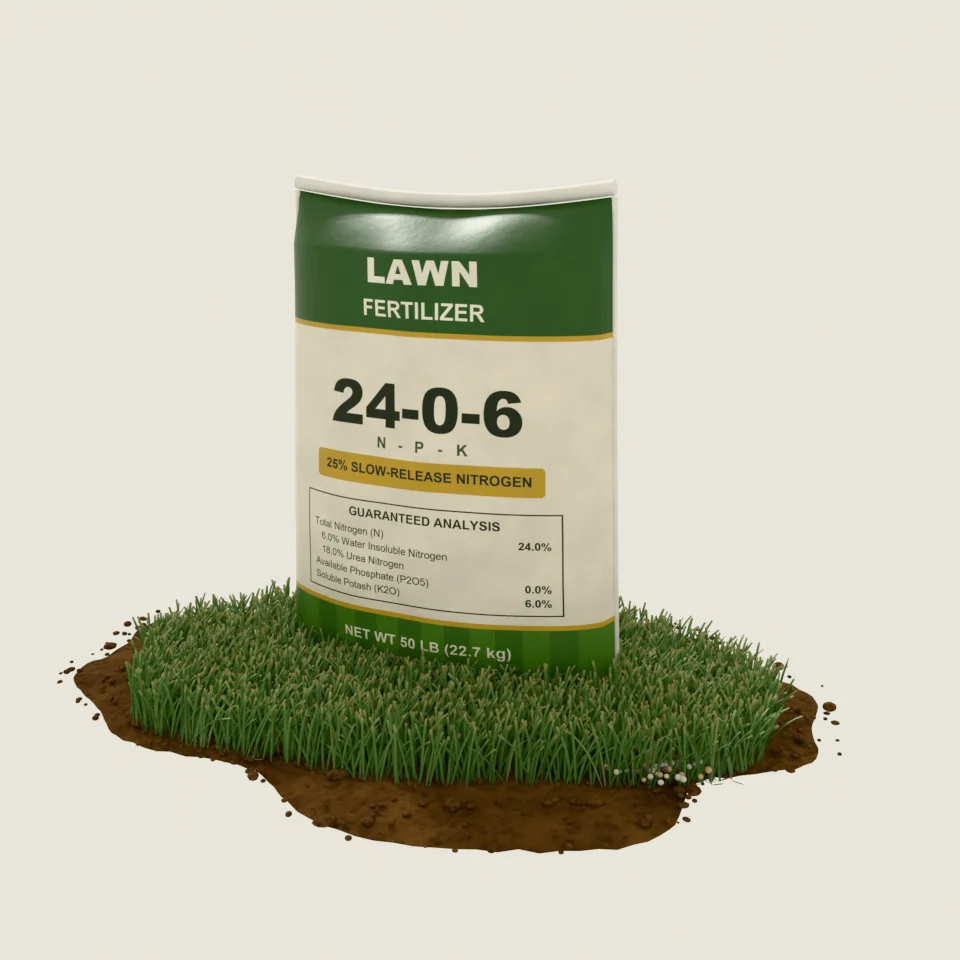
Greening and growth. Most lawns need only this, and the label says how much is slow-release.
Root growth. A zero here is normal: add it only when a soil test is low or at seeding.
Stress, drought and cold tolerance. Feed it when the test says so.
The guaranteed analysis splits the nitrogen: "6.0% water-insoluble" or "polymer-coated urea" is slow-release. 6 of 24 = 25% slow-release.
What is in your bag
| Bag | Slow N | ½ lb N | ¾ lb N | 1 lb N | What it is |
|---|---|---|---|---|---|
| 24-0-6 | 25% | 2.1 | 3.1 | 4.2 | typical lawn food, part slow-release |
| 29-0-4 | 50% | 1.7 | 2.6 | 3.4 | high-N lawn food, half slow-release |
| 16-4-8 | 25% | 3.1 | 4.7 | 6.3 | 4-1-2 turf ratio, for low-P soils |
| 10-10-10 | 0% | 5.0 | 7.5 | 10 | garden grade, only if P and K test low |
| 46-0-0 | 0% | 1.1 | 1.6 | 2.2 | urea, all quick-release |
| 21-0-0 | 0% | 2.4 | 3.6 | 4.8 | ammonium sulfate, quick, acidifying |
| 6-4-0 | 85% | 8.3 | 12.5 | 16.7 | heat-dried biosolids, slow organic |
| 15-0-15 | 30% | 3.3 | 5.0 | 6.7 | high-potassium, for centipede |
Grey figures would put more than ½ lb of quick-release nitrogen down at once; with those bags use the ½ lb column and feed more often.
5.Spreading fertilizer evenly
Most lawn streaks and burnt stripes come from the spreader, not the product. A rotary or broadcast spreader throws granules in a fan 6 to 12 feet wide and forgives small steering errors; a drop spreader puts them in a narrow band and leaves a stripe wherever passes miss or overlap. The setting printed on a bag is only a starting point, because walking speed, humidity and granule size all change the rate.
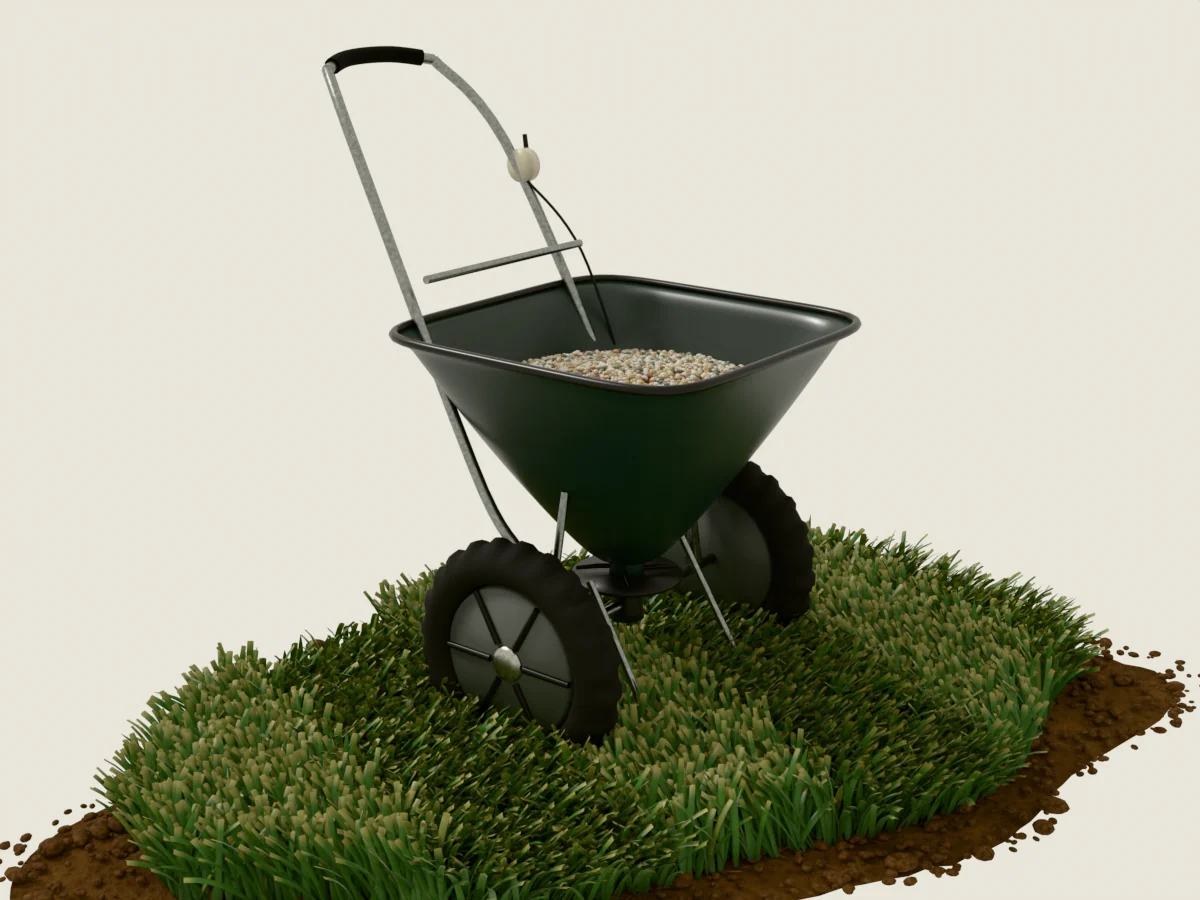
- Calibrate first. Weigh product, spread it over a measured 1,000 sq ft, weigh again and adjust the setting.
- Fill on the driveway. Fill on pavement or a tarp, never on the grass; spilled granules burn a patch.
- Header strips. Make two passes round the edge, then go back and forth across the middle.
- Half rate, two ways. Set for half the rate and cover the lawn twice at right angles to stop stripes.
- Overlap to the wheel track. A rotary throw thins at the edges: run each pass into the last one's wheel marks.
- Close at turns. Shut the hopper whenever you stop or turn, and keep the deflector on near beds and water.
Check your spreader's real rate
Weigh the spreader with product, cover a measured patch, weigh it again. The difference is what went down.
6.Watering in and keeping it out of water
Granules sitting on wet blades can scorch them, and urea left on the surface loses part of its nitrogen to the air as ammonia. About a quarter inch of water the same day moves the fertilizer into the soil where roots can use it. The same care keeps it out of drains and streams, where nitrogen and phosphorus feed algae.
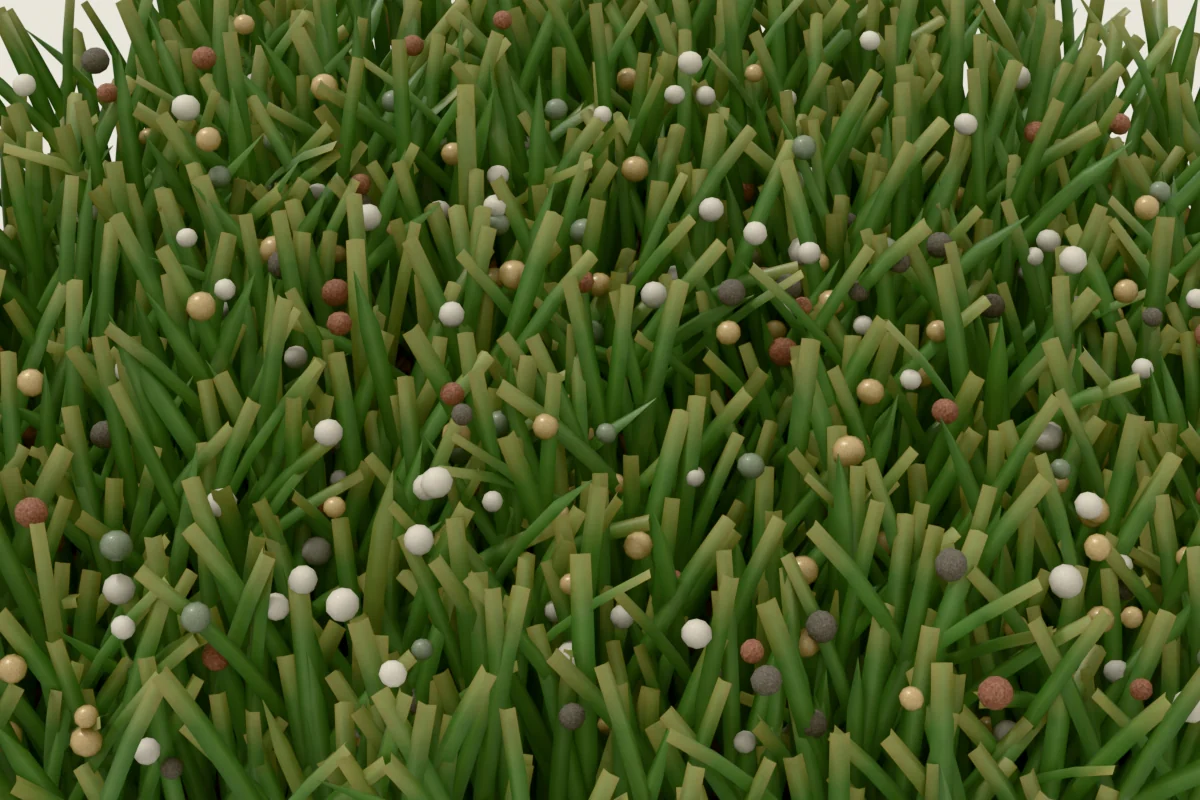
Water quick-release fertilizer in the same day: it washes granules off the blades, stops leaf burn and loses less urea to the air.
Skip feeding when heavy rain is forecast or the ground is frozen; it runs off into drains and streams.
Blow or sweep granules from walks and drives back onto the lawn.
Products with a broadleaf killer go on dew-wet grass and stay unwatered for 24 hours; read the label.
Leave a 10 to 15 ft unfed strip beside ponds, streams and ditches.
7.Soil test first: lime, phosphorus and clippings
No soil test measures how much nitrogen a lawn needs; that comes from the schedule. A soil test does tell you the pH and whether phosphorus or potassium is short, and those are the two things a bag of lawn food will not fix by itself. Test every two to three years, every year on sandy soil, and send the sample to your state's extension laboratory.
| Grass | pH | Lime |
|---|---|---|
| Most grasses | 6.0–7.0 | lime if below 6.0 |
| Centipedegrass | 5.0–6.0 | do not lime above 6.0 |
| Bahia, St. Augustine | 5.5–7.0 | lime only on a test |
| Fine fescue | 5.5–6.5 | tolerates acid soil |
Up to 50 lb ground limestone per 1,000 sq ft at a time on established turf, fall or winter.
Test every 2 to 3 years (sandy soils every year): pH, P and K. No soil test measures lawn nitrogen.
Add phosphorus only when a soil test is low, or when seeding or laying sod. Most established lawns have enough, and phosphorus washed off lawns feeds algae in lakes.
Several states, Minnesota among them, restrict phosphorus fertilizer on lawns unless a test shows a need or a new lawn is being established. Check your state's rules before buying a bag with a middle number.
Leave the clippings: returned clippings supply about 1 lb N per 1,000 sq ft a year. Bag them and the lawn needs 25 to 50% more nitrogen.
Sources and notes
Cool-season timing, the 1 lb per feeding limit, the slow-release rule and the clippings adjustment follow Purdue Extension publication AY-22-W and Penn State Extension. Warm-season calendars follow the NC State TurfFiles lawn maintenance calendars, Clemson HGIC, UGA and Texas A&M AgriLife; Florida rates follow UF/IFAS. Monthly figures are a moderate program for a lawn with clippings returned; your county extension office can adjust them for local soils and weather. Phosphorus rules differ by state and change over time, so check your own state's law.
- Purdue Extension AY-22-W, Fertilizing Established Cool-season Lawns (Bigelow, Camberato and Patton, 2013)
- Penn State Extension, lawn fertilization and soil test recommendations for home lawns
- University of Minnesota Extension, fertilizing lawns; Minnesota Department of Agriculture phosphorus lawn fertilizer law
- NC State TurfFiles lawn maintenance calendars: tall fescue, bermudagrass, zoysiagrass, St. Augustinegrass, centipedegrass
- UGA Cooperative Extension, warm-season lawn fertilization and large patch disease
- Clemson Cooperative Extension HGIC, Fertilizing Lawns and Centipedegrass fact sheets
- Texas A&M AgriLife Extension, Fertilizing Texas Lawns and Maintaining St. Augustinegrass Lawns
- University of Florida IFAS Extension EP353, the Florida lawn fertilization table