
Horse Coat Color Chart
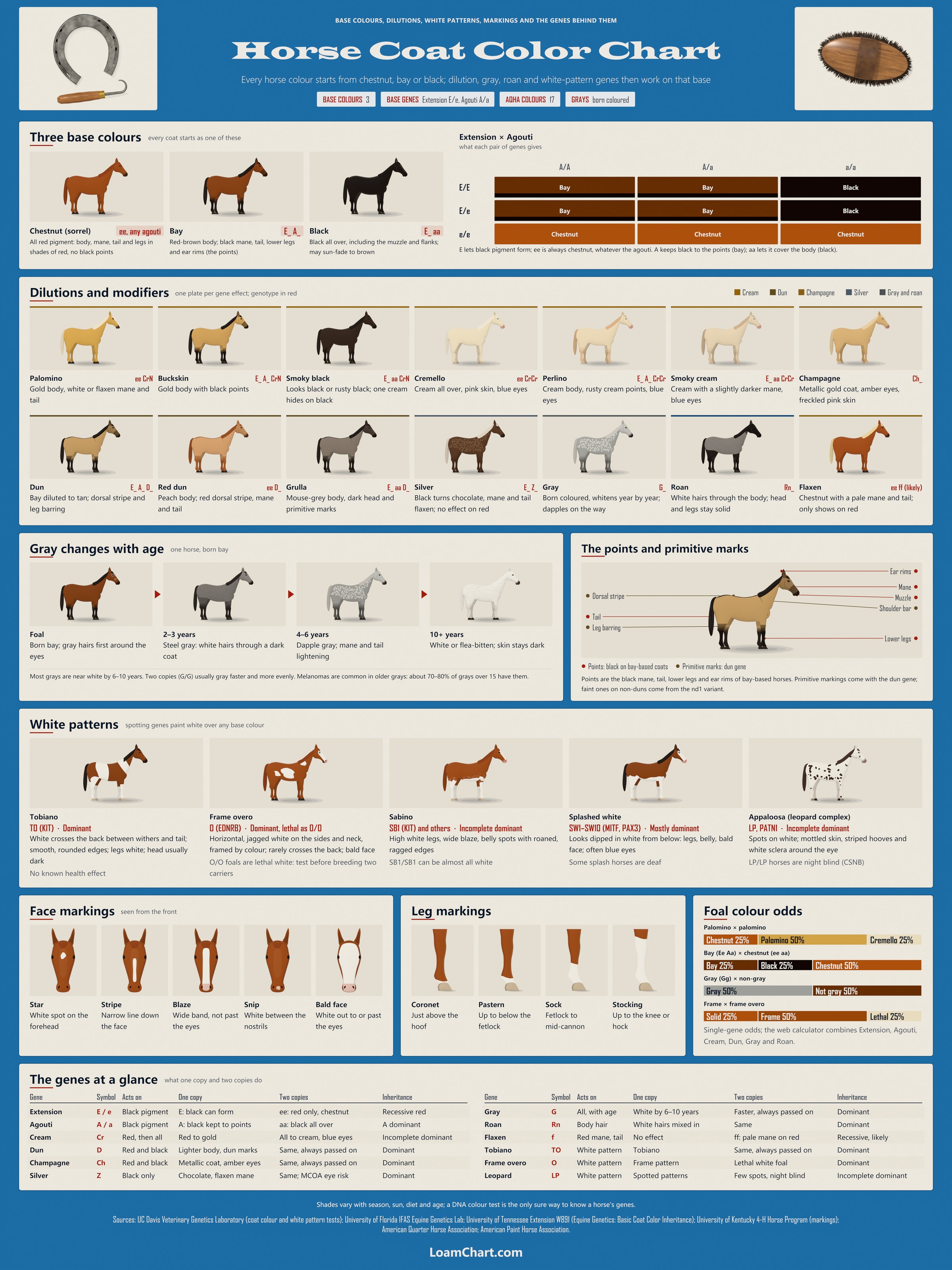
Every horse colour starts as chestnut, bay or black. Dilution genes such as cream, dun, champagne and silver lighten that base, gray and roan add white hairs, and spotting genes paint white patterns over it. This chart shows each colour, the genes behind it and how to read the markings.
1.Two genes make the three base colours
Two genes decide the base coat. Extension (E or e) decides whether a horse can make black pigment at all: a horse with two copies of e (ee) makes only red pigment and is chestnut, whatever else it carries. Agouti (A or a) only matters when black pigment can form. One or two copies of A push black to the points, the mane, tail, lower legs and ear rims, which makes a bay; two copies of a (aa) let black cover the whole body. Every other colour on the chart is one of these three bases with something added.

Chestnut or sorrel
All red pigment: body, mane, tail and legs in shades of red, no black points.

Bay
Red-brown body; black mane, tail, lower legs and ear rims (the points).

Black
Black all over, including the muzzle and flanks; may sun-fade to brown.
| Extension | A/A | A/a | a/a |
|---|---|---|---|
| E/E | Bay | Bay | Black |
| E/e | Bay | Bay | Black |
| e/e | Chestnut | Chestnut | Chestnut |
Read across from the Extension genotype to the Agouti genotype. A chestnut can carry any agouti, hidden, and pass it on; that is why two chestnut parents can never have a bay or black foal, while a chestnut bred to a black can produce bays. UC Davis and other laboratories test both genes from a hair sample.
2.Every coat on the chart, by gene
Pick a gene to see the coats it makes. The genotype in red lists only the genes that matter for that colour: an underscore means the second copy can be either version, so E_ stands for E/E or E/e.
17 coats
-
Chestnut
All red pigment: body, mane, tail and legs in shades of red, no black points.
-
Bay
Red-brown body; black mane, tail, lower legs and ear rims (the points).
-
Black
Black all over, including the muzzle and flanks; may sun-fade to brown.

Palomino
Gold body, white or flaxen mane and tail.

Buckskin
Gold body with black points.

Smoky black
Looks black or rusty black; one cream hides on black.

Cremello
Cream all over, pink skin, blue eyes.

Perlino
Cream body, rusty cream points, blue eyes.

Smoky cream
Cream with a slightly darker mane, blue eyes.

Champagne
Metallic gold coat, amber eyes, freckled pink skin.

Dun
Bay diluted to tan; dorsal stripe and leg barring.

Red dun
Peach body; red dorsal stripe, mane and tail.

Grulla
Mouse-grey body, dark head and primitive marks.

Silver
Black turns chocolate, mane and tail flaxen; no effect on red.

Gray
Born coloured, whitens year by year; dapples on the way.

Roan
White hairs through the body; head and legs stay solid.

Flaxen
Chestnut with a pale mane and tail; only shows on red.
3.Foal colour odds from the parents
Choose a colour for the sire and the dam to fill in a likely genotype, then change any gene to match a DNA test. Each parent passes one copy of every gene, picked at random, so the odds below are the share of foals you would expect over many matings. Presets assume one copy where a horse could carry one or two, so a bay is set to E/e A/a.
Sire
Dam
| Coat | Colour | Chance | % |
|---|---|---|---|
|
Palomino | 50% | |
|
Chestnut | 25% | |
|
Cremello | 25% |
Covers Extension, Agouti, Cream, Dun, Gray and Roan. White patterns, champagne and silver follow the same rule: a horse with one copy of a dominant gene passes it to about half its foals. Breeding two frame overo carriers gives a one in four chance of a lethal white foal.
4.A gray horse whitens with age
Gray is not a colour a foal is born with. A gray foal arrives bay, black, chestnut or any other colour, and the gray gene then replaces its coloured hairs with white ones year by year, often starting around the eyes. Most grays pass through steel gray and dapple gray and are nearly white by 6 to 10 years old, while the skin stays dark. A horse needs only one gray parent to be gray.
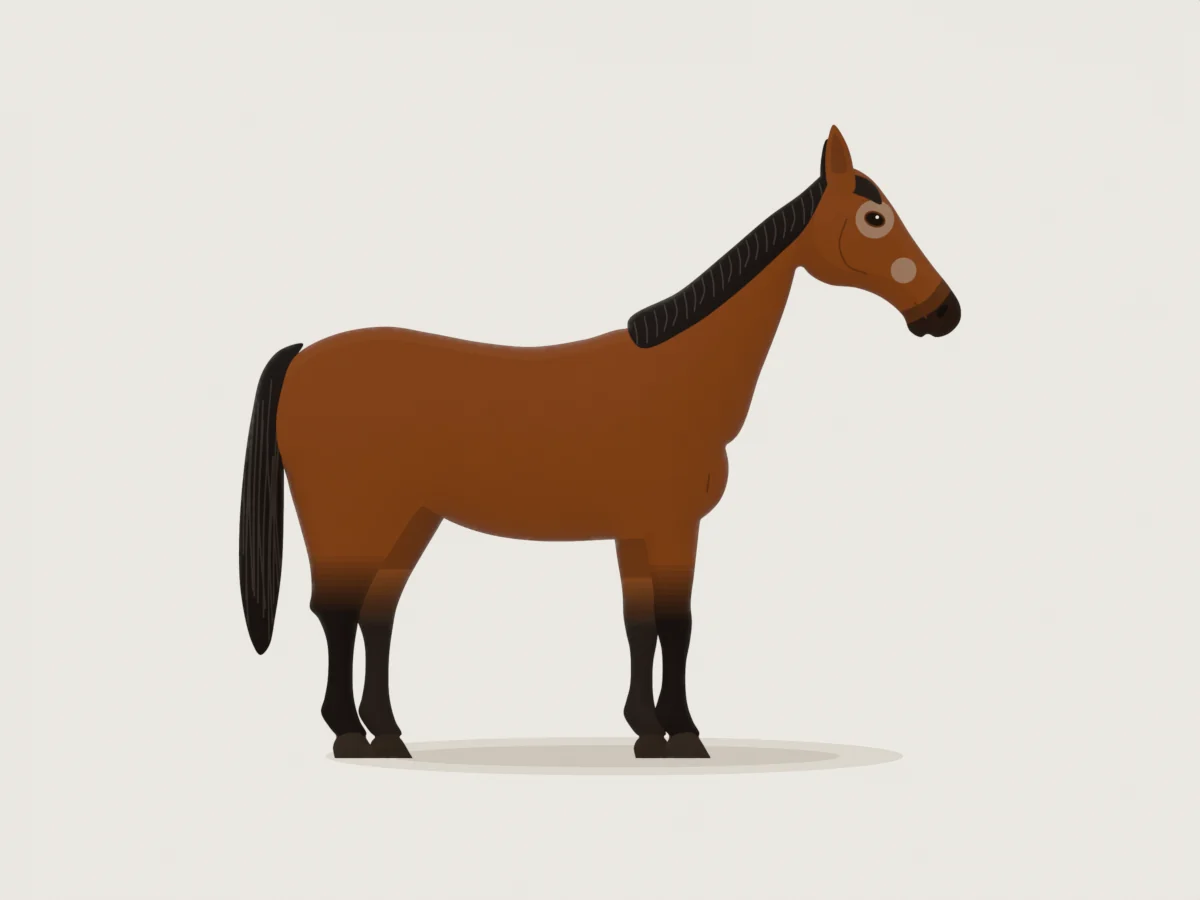
Foal
Born bay; gray hairs first around the eyes.
Two copies of gray (G/G) usually gray faster and more evenly and always pass gray on. Melanomas are common in older grays, about 70–80% of grays over 15 have them, so check under the tail and around the eyes and lips once a year.
5.Points and primitive marks
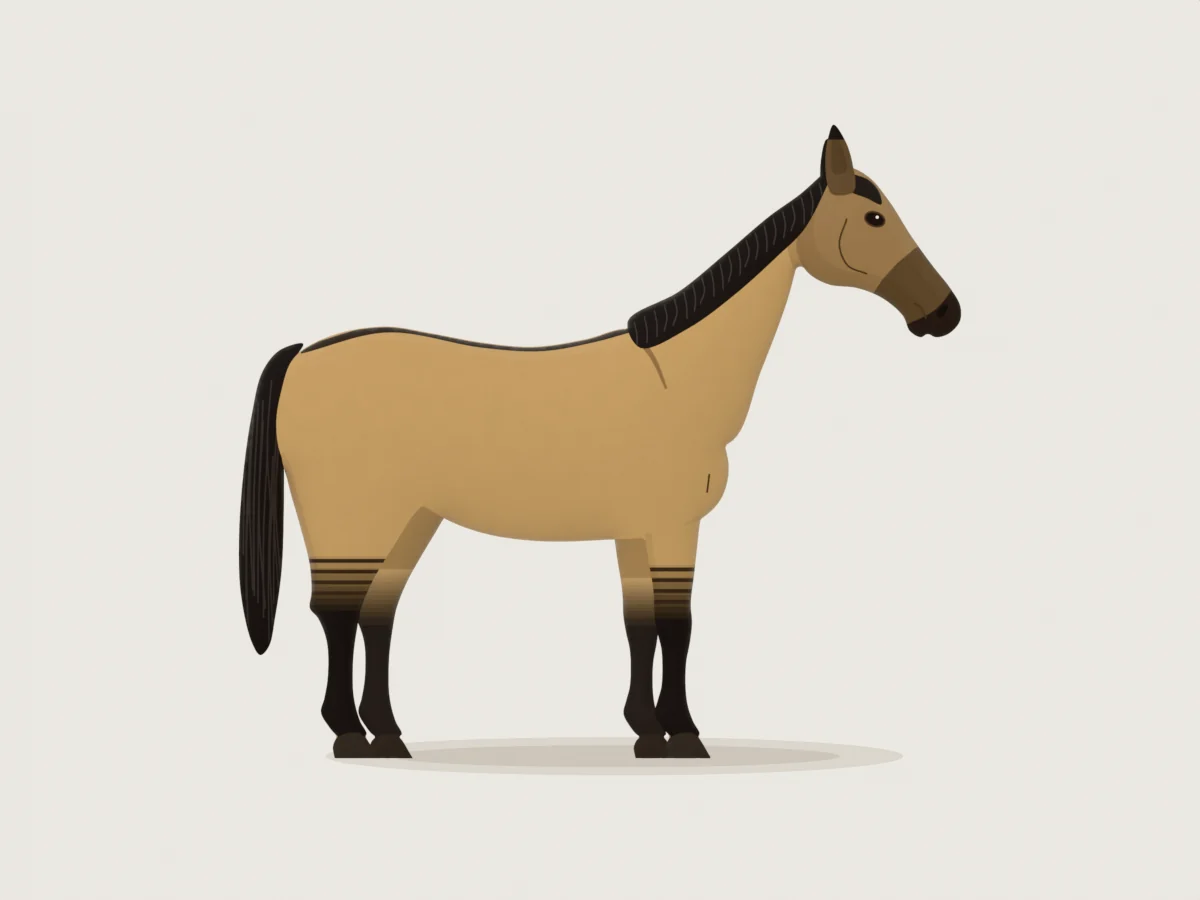
The points are the black mane, tail, lower legs and ear rims of a bay-based horse; they tell a bay from a chestnut at a glance, and a buckskin from a palomino. Primitive marks come with the dun gene: a dark dorsal stripe along the spine, sometimes a shoulder bar, and zebra-like barring on the legs. The head of a dun stays darker than the body.
| Mark | Where | From |
|---|---|---|
| Mane and tail | Black hair along the crest and in the tail | Agouti (points) |
| Lower legs | Black from about the knees and hocks down | Agouti (points) |
| Ear rims | Black edges and tips of the ears | Agouti (points) |
| Dorsal stripe | Dark line from withers to tail | Dun (primitive) |
| Shoulder bar | Faint dark band across the withers | Dun (primitive) |
| Leg barring | Dark horizontal bars above the knees and hocks | Dun (primitive) |
6.White patterns and their genes
Spotting genes remove pigment from patches of skin and hair, so the white sits on pink skin. They work on any base colour and a horse can carry several at once; the American Paint Horse Association calls a horse with tobiano and an overo gene a tovero. Some patterns carry health risks worth testing for before breeding.

Tobiano
White crosses the back between withers and tail; smooth, rounded edges; legs white; head usually dark. No known health effect.

Frame overo
Horizontal, jagged white on the sides and neck, framed by colour; rarely crosses the back; bald face. O/O foals are lethal white: test before breeding two carriers.

Sabino
High white legs, wide blaze, belly spots with roaned, ragged edges. SB1/SB1 can be almost all white.

Splashed white
Looks dipped in white from below: legs, belly, bald face; often blue eyes. Some splash horses are deaf.

Appaloosa (leopard complex)
Spots on white; mottled skin, striped hooves and white sclera around the eye. LP/LP horses are night blind (CSNB).
7.Face and leg markings
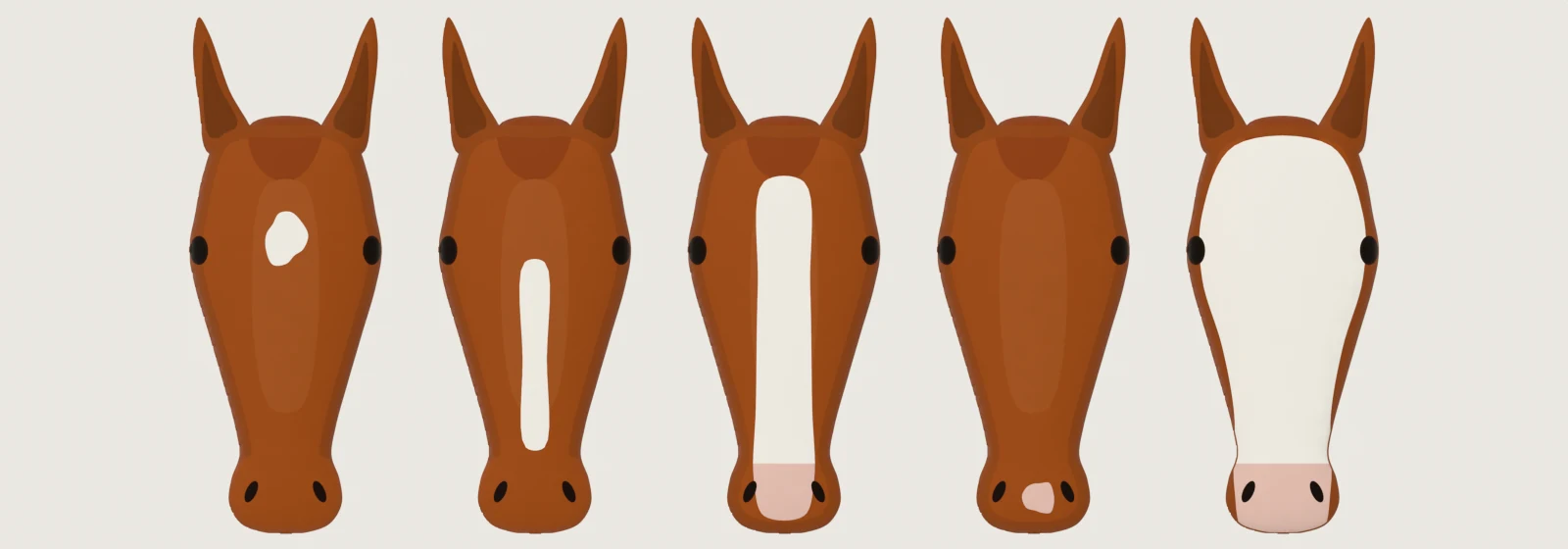
Markings are the small white areas on the face and legs that identify a horse on registration papers and vet records. They are named by shape on the face and by how high the white reaches on the leg. Most are inherited loosely and vary even between full siblings.
| Marking | What it is |
|---|---|
| Star | White spot on the forehead |
| Stripe | Narrow line down the face |
| Blaze | Wide band, not past the eyes |
| Snip | White between the nostrils |
| Bald face | White out to or past the eyes |
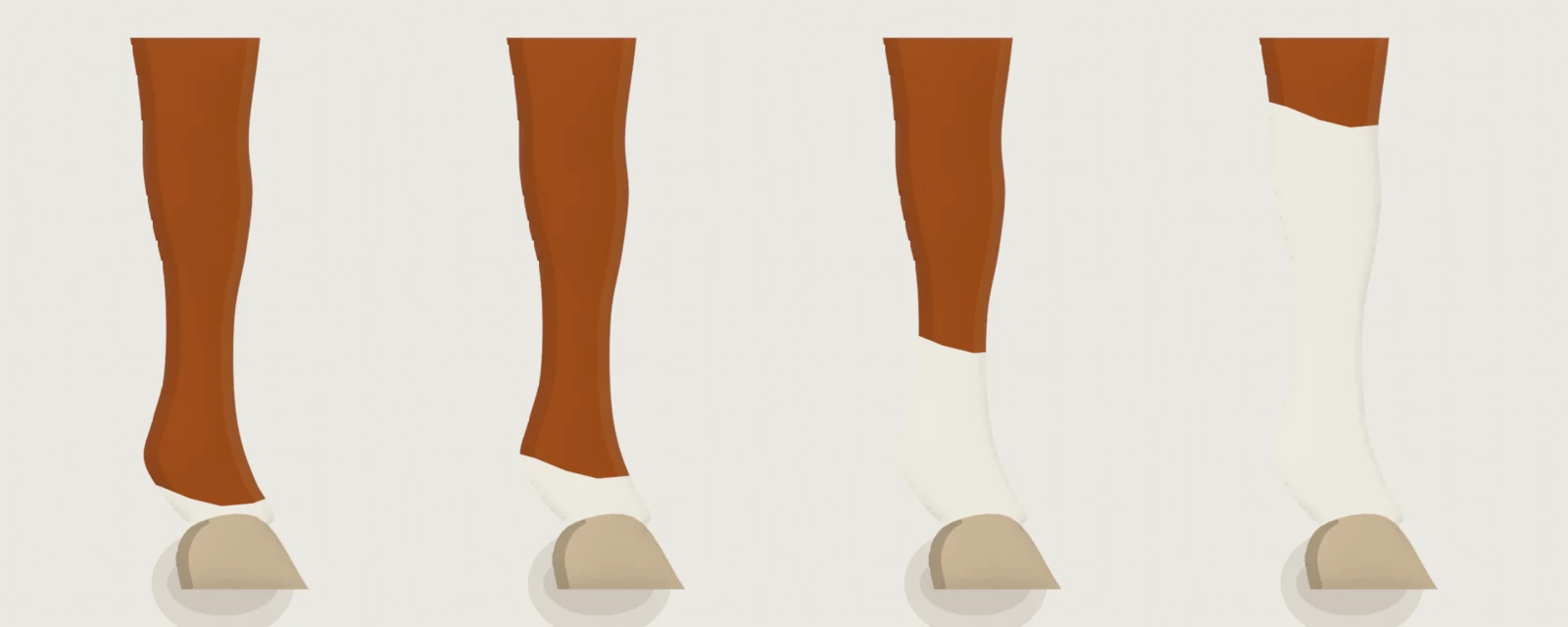
| Marking | How high the white reaches |
|---|---|
| Coronet | Just above the hoof |
| Pastern | Up to below the fetlock |
| Sock | Fetlock to mid-cannon |
| Stocking | Up to the knee or hock |
8.The genes in one table
What one copy and two copies of each gene do. Dominant genes show with one copy; a recessive gene shows only when a horse has two.
| Gene | Symbol | One copy | Two copies |
|---|---|---|---|
| Extension | E / e | E: black can form | ee: red only, chestnut |
| Agouti | A / a | A: black kept to points | aa: black all over |
| Cream | Cr | Red to gold | All to cream, blue eyes |
| Dun | D | Lighter body, dun marks | Same, always passed on |
| Champagne | Ch | Metallic coat, amber eyes | Same, always passed on |
| Silver | Z | Chocolate, flaxen mane | Same; MCOA eye risk |
| Gray | G | White by 6–10 years | Faster, always passed on |
| Roan | Rn | White hairs mixed in | Same |
| Flaxen | f | No effect | ff: pale mane on red |
| Tobiano | TO | Tobiano | Same, always passed on |
| Frame overo | O | Frame pattern | Lethal white foal |
| Leopard | LP | Spotted patterns | Few spots, night blind |
Sources and notes
Gene effects follow the UC Davis Veterinary Genetics Laboratory coat colour and white pattern test descriptions and the University of Florida equine genetics laboratory; colour names follow the American Quarter Horse Association, which recognises 17 colours, and the American Paint Horse Association. Marking definitions follow 4-H horse programme material. Coat shades vary with season, sun bleaching, diet and age, and modifiers not shown here, such as sooty and pangaré, shift them further. Flaxen is probably recessive but its genes are not yet known. A DNA colour test is the only sure way to know a horse's genotype.
- UC Davis Veterinary Genetics Laboratory: Horse coat colour tests (Extension, Agouti, Cream, Dun, Silver, Gray, Roan) and white pattern tests (Leopard complex, Frame overo, Sabino 1, Splashed white, Tobiano)
- University of Florida IFAS, Equine Genetics Laboratory: Coat color genetics
- University of Tennessee Extension W891: Equine Genetics: Basic Coat Color Inheritance
- University of Kentucky Cooperative Extension, 4-H Horse Program: horse colors, patterns and markings
- American Quarter Horse Association: Quarter Horse Markings and Color Genetics
- American Paint Horse Association: coat patterns and color genetics
- Curik I. et al. (2013). Complex inheritance of melanoma and pigmentation of coat and skin in grey horses. PLoS Genetics 9(2)