
Goat Gestation Chart
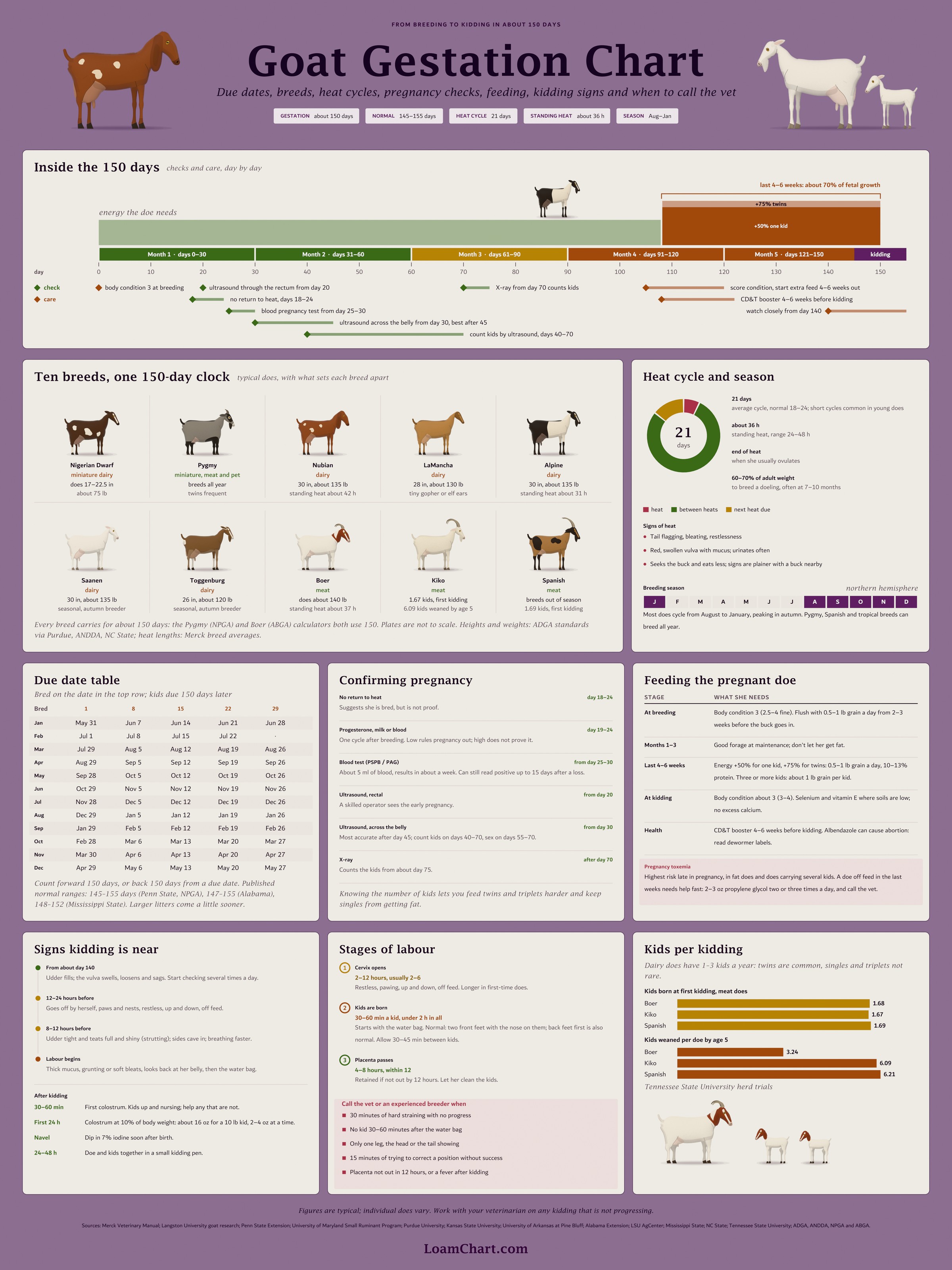
A doe carries her kids for about 150 days, normally 145 to 155. Work out a kidding date, compare ten breeds, plan heats and pregnancy checks, feed for the last six weeks and know when labour needs help.
Contents
1.Working out the kidding date
Count 150 days from the day she was bred. Most does kid within five days either side, and larger litters tend to come a little sooner. Enter a breeding date, or a due date to work backwards, and the list gives every date worth writing on the calendar.
Every breed in this chart averages about 150 days. The kid count changes the feeding advice in the list, not the date: the sources give no fixed number of days for a larger litter.
Today is day 26 of about 150: month 1, 124 days to go.
- Thu Oct 1, 2026Bredday 0
- Mon Oct 19, 2026Watch for a return to heatthrough day 24; no heat suggests she is bred
- Mon Oct 26, 2026Earliest blood pregnancy testday 25–30; ultrasound through the rectum from day 20
- Sun Nov 15, 2026Ultrasound across the belly, clearestfrom day 30; count kids on days 40–70
- Sun Jan 17, 2027Start late-pregnancy feedingenergy +75% for twins; score body condition
- Sun Jan 24, 2027CD&T booster4–6 weeks before kidding
- Thu Feb 18, 2027Watch closelykidding pen ready; udder filling, vulva loosening
- Tue Feb 23, 2027Normal window opens
- Sun Feb 28, 2027Due dateday 150
- Fri Mar 5, 2027Normal window closescall your veterinarian if she is well past it
2.Ten breeds share one clock
Unlike cattle, goat breeds do not differ much in pregnancy length. The Pygmy and Boer breed associations both count 150 days, and extension sources give 145 to 155 for goats in general. What differs is size, season and litter: dairy breeds are tall, miniatures and meat breeds often breed outside the autumn season.

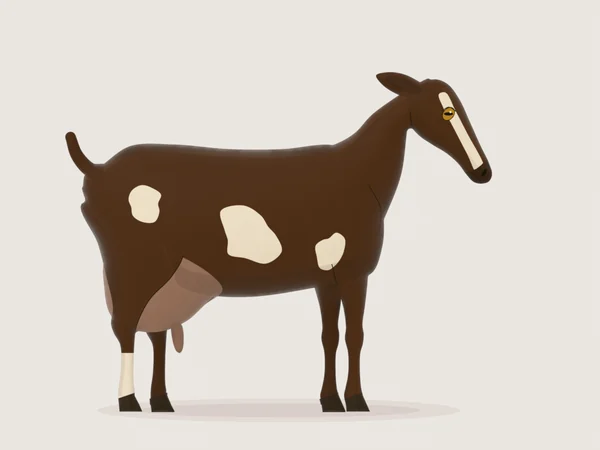
Nigerian Dwarf
Miniature dairy- Does 17–22.5 in at the withers, about 75 lb (ANDDA)
- Rich milk from a small doe
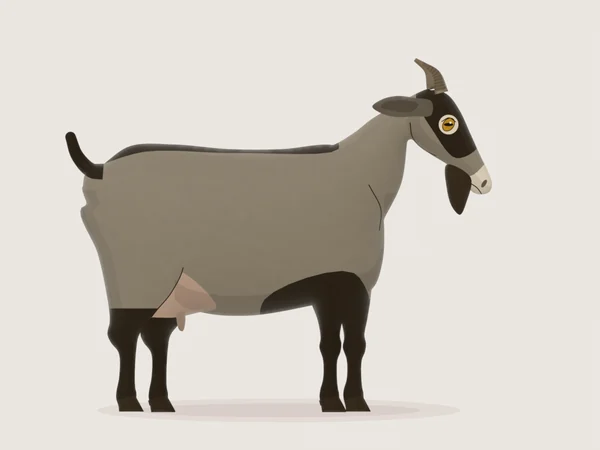
Pygmy
Miniature, meat and pet- Usually breeds all year; twins frequent
- Puberty can come as early as 3 months
- NPGA calculator: 150 days, 145–155
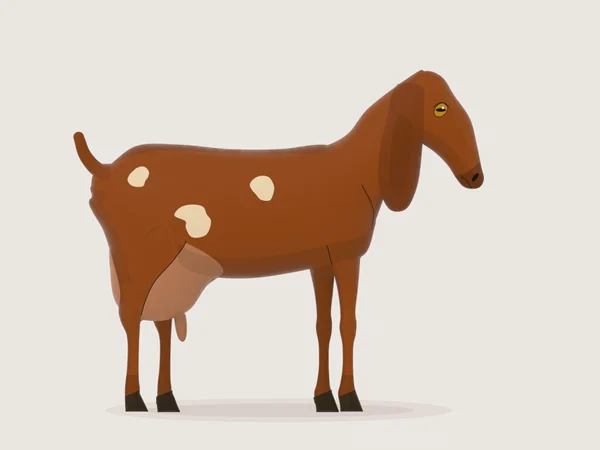
Nubian
Dairy- 30 in, about 135 lb (ADGA)
- Long hanging ears and a Roman nose
- Standing heat about 42 h, the longest here
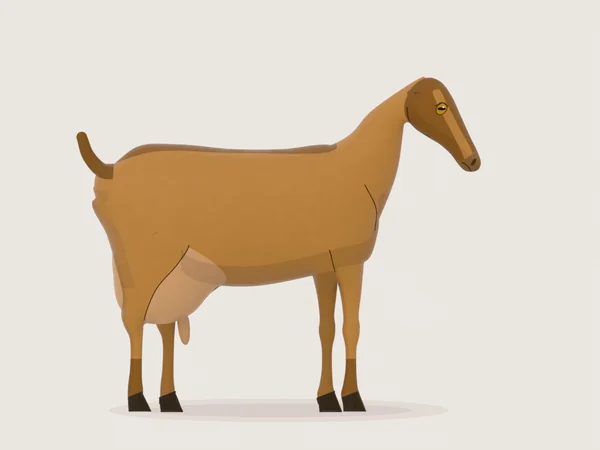
LaMancha
Dairy- 28 in, about 130 lb (ADGA)
- Tiny gopher or elf ears
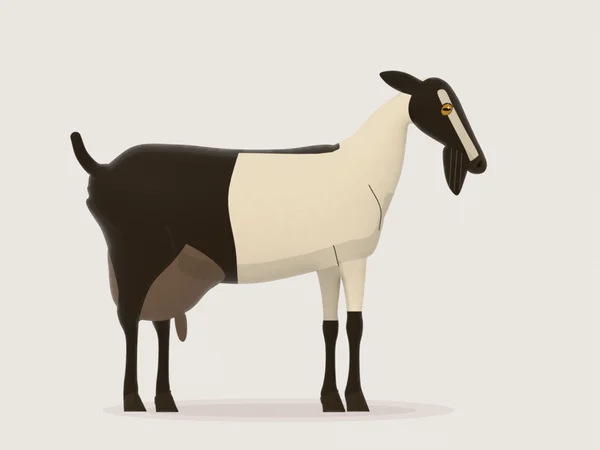
Alpine
Dairy- 30 in, about 135 lb (ADGA)
- Standing heat about 31 h
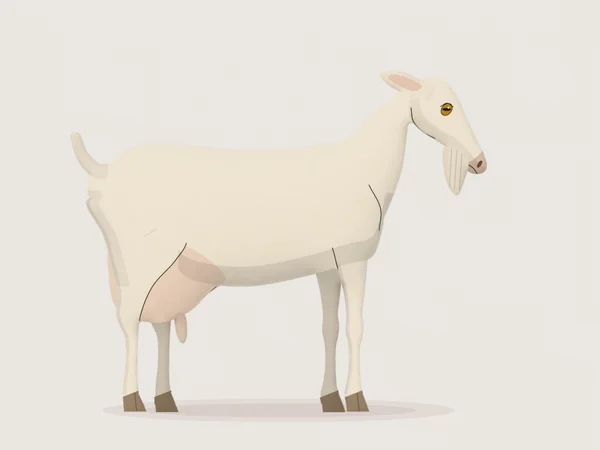
Saanen
Dairy- 30 in, about 135 lb (ADGA)
- Seasonal: an autumn breeder
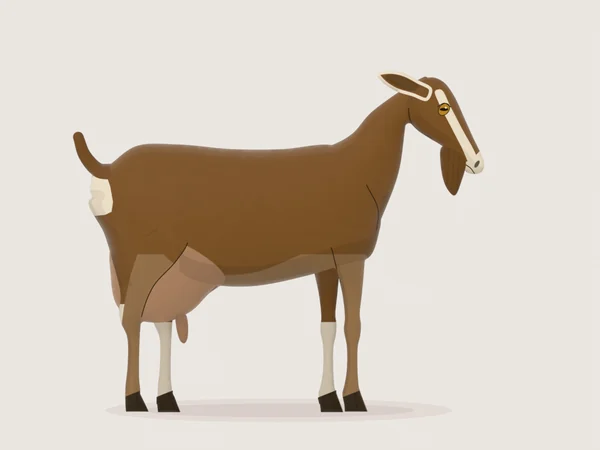
Toggenburg
Dairy- 26 in minimum, about 120 lb (ADGA)
- Brown with white facial stripes and legs
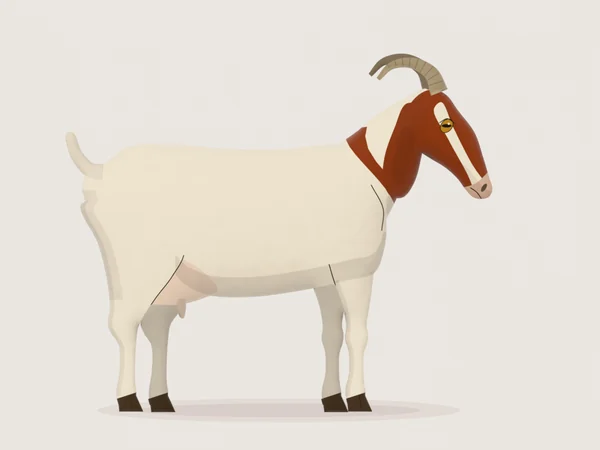
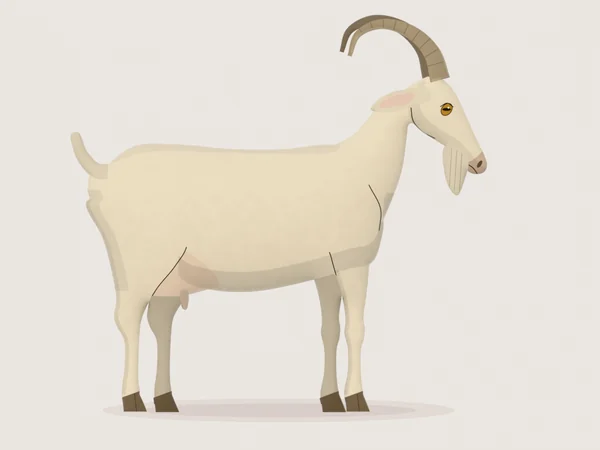
Boer
Meat- Does average about 140 lb, up to 200 (NC State)
- Standing heat about 37 h
- 1.68 kids at first kidding; 3.24 weaned by age 5
Kiko
Meat- Prolific and hardy (Langston)
- 1.67 kids at first kidding; 6.09 weaned by age 5
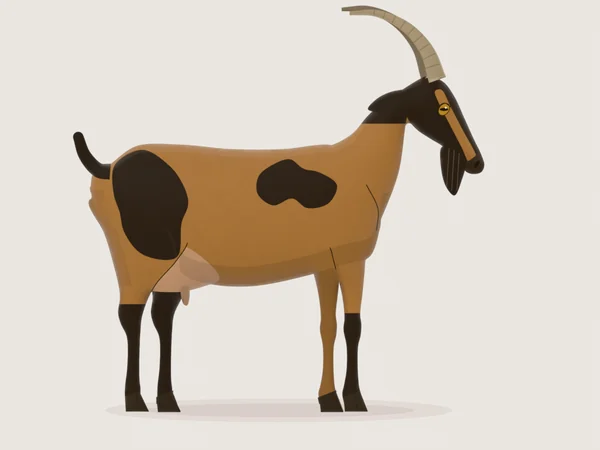
Spanish
Meat- Breeds out of season (NC State)
- 1.69 kids at first kidding; 6.21 weaned by age 5
Heights and weights: ADGA breed standards as given by Purdue University, ANDDA for the Nigerian Dwarf and NC State for the Boer. Heat lengths are breed averages from the Merck Veterinary Manual. Litter figures for Boer, Kiko and Spanish does are from Tennessee State University herd trials.
3.Due dates for every breeding date
Pick the month she was bred to see the kidding date for every day of it, 150 days on. The window column shows the normal spread of 145 to 155 days.
| Bred | Due | Window |
|---|---|---|
| Oct 1 | Sun Feb 28 | Feb 23 to Mar 5 |
| Oct 2 | Mon Mar 1 | Feb 24 to Mar 6 |
| Oct 3 | Tue Mar 2 | Feb 25 to Mar 7 |
| Oct 4 | Wed Mar 3 | Feb 26 to Mar 8 |
| Oct 5 | Thu Mar 4 | Feb 27 to Mar 9 |
| Oct 6 | Fri Mar 5 | Feb 28 to Mar 10 |
| Oct 7 | Sat Mar 6 | Mar 1 to Mar 11 |
| Oct 8 | Sun Mar 7 | Mar 2 to Mar 12 |
| Oct 9 | Mon Mar 8 | Mar 3 to Mar 13 |
| Oct 10 | Tue Mar 9 | Mar 4 to Mar 14 |
| Oct 11 | Wed Mar 10 | Mar 5 to Mar 15 |
| Oct 12 | Thu Mar 11 | Mar 6 to Mar 16 |
| Oct 13 | Fri Mar 12 | Mar 7 to Mar 17 |
| Oct 14 | Sat Mar 13 | Mar 8 to Mar 18 |
| Oct 15 | Sun Mar 14 | Mar 9 to Mar 19 |
| Oct 16 | Mon Mar 15 | Mar 10 to Mar 20 |
| Bred | Due | Window |
|---|---|---|
| Oct 17 | Tue Mar 16 | Mar 11 to Mar 21 |
| Oct 18 | Wed Mar 17 | Mar 12 to Mar 22 |
| Oct 19 | Thu Mar 18 | Mar 13 to Mar 23 |
| Oct 20 | Fri Mar 19 | Mar 14 to Mar 24 |
| Oct 21 | Sat Mar 20 | Mar 15 to Mar 25 |
| Oct 22 | Sun Mar 21 | Mar 16 to Mar 26 |
| Oct 23 | Mon Mar 22 | Mar 17 to Mar 27 |
| Oct 24 | Tue Mar 23 | Mar 18 to Mar 28 |
| Oct 25 | Wed Mar 24 | Mar 19 to Mar 29 |
| Oct 26 | Thu Mar 25 | Mar 20 to Mar 30 |
| Oct 27 | Fri Mar 26 | Mar 21 to Mar 31 |
| Oct 28 | Sat Mar 27 | Mar 22 to Apr 1 |
| Oct 29 | Sun Mar 28 | Mar 23 to Apr 2 |
| Oct 30 | Mon Mar 29 | Mar 24 to Apr 3 |
| Oct 31 | Tue Mar 30 | Mar 25 to Apr 4 |
Published normal ranges: 145–155 days (Penn State, NPGA), 147–155 (Alabama Extension), 148–152 (Mississippi State). The ABGA advises watching does from 10 days before to 10 days after the due date.
4.The pregnancy month by month
The first three months are quiet: the kids are small and the doe needs little more than good forage. About 70% of fetal growth comes in the last four to six weeks, which is when her energy needs rise by half for a single kid and by three quarters for twins. Choose a month to see what to do.
Watch for a return to heat 18–24 days after breeding. A progesterone test one cycle later can rule pregnancy out.
- No return to heat, days 18–24
- Progesterone test, days 19–24
- Ultrasound through the rectum from day 20
- Blood pregnancy test from day 25–30
- Body condition about 3; good forage, no extra grain
Bar heights show the doe’s energy need against maintenance (Penn State Extension), not the size of the kids.
- Month 1days 0–30Watch for a return to heat 18–24 days after breeding. A progesterone test one cycle later can rule pregnancy out.
- Month 2days 31–60Pregnancy is confirmed and the kids can be counted. Ultrasound across the belly works from day 30 and is clearer after day 45.
- Month 3days 61–90Still a quiet month for feeding. Finish any kid counts: ultrasound counting is most accurate up to about day 85, and an X-ray counts kids after day 75.
- Month 4days 91–120Late pregnancy begins: score body condition 4–6 weeks before kidding and start the extra feed, matched to the number of kids.
- Month 5days 121–150About 70% of fetal growth happens now. Energy needs are 50% above maintenance for one kid and 75% for twins; watch for a doe going off feed.
5.Confirming she is bred
A doe that does not come back into heat 18 to 24 days after breeding is probably pregnant, but only a test confirms it. Counting the kids by ultrasound in the second month lets you feed a doe with twins or triplets harder and keep one with a single from getting fat.
| Method | From | Notes |
|---|---|---|
| No return to heat | day 18–24 | Suggests she is bred, but is not proof. |
| Progesterone, milk or blood | day 19–24 | Taken one cycle after breeding. Low rules pregnancy out; high does not prove it. |
| Blood test (PSPB or PAG) | day 25–30 | About 5 ml of blood; results in about a week. Can still read positive up to 15 days after a pregnancy is lost. |
| Ultrasound through the rectum | day 20 | Needs a skilled operator. |
| Ultrasound across the belly | day 30 | Most accurate after day 45. Count kids on days 40–70 (accurate to about day 85); sex on days 55–70. |
| X-ray | day 70 | Counts the kids from about day 75. |
Your check dates
Bred on Oct 1, 2026 (from the calculator above).
- Watch for a return to heat (to day 24)Oct 19, 2026
- Progesterone test window opensOct 20, 2026
- Blood pregnancy testOct 26, 2026
- Ultrasound across the bellyOct 31, 2026
- Ultrasound clearest; count kidsNov 15, 2026
- Last good day to count kids (to day 85)Dec 10, 2026
6.Heat cycles and the breeding season
Goats are short-day breeders: most does cycle from about August to January in the northern hemisphere, peaking in autumn. A heat comes about every 21 days, and a doe stands for the buck for about a day and a half.

Heat cycle planner
- Heat 1: expect aboutOct 1, 2026 (Sep 28 to Oct 4)
- Heat 2: expect aboutOct 22, 2026 (Oct 16 to Oct 28)
- Heat 3: expect aboutNov 12, 2026 (Nov 3 to Nov 21)
- If bred at heat 1, kids due aboutFeb 28, 2027
The next heat falls in the main breeding season.
Short cycles are common in young does and early in the season, and longer ones late in it, so watch from a few days before each date.
When does cycle
Shaded: the main season, August to January, with January carrying on from December. Pygmy, Spanish and tropical breeds can breed all year; nutrition matters more than day length for Boers. Bringing a buck in early can bring does into heat sooner.
Standing heat by breed
Breed averages, Merck Veterinary Manual.
| 21 days | average cycle; normal 18–24 days |
|---|---|
| about 36 h | standing heat, range 24–48 hours (Merck); Langston gives about 30 hours |
| end of heat | when ovulation usually happens, so a doe bred late in her heat is well timed |
| signs | tail flagging, bleating, restlessness, a red swollen vulva with mucus, frequent urination, seeking the buck and eating less; all plainer with a buck nearby |
| doelings | breed at 60–70% of adult weight, usually at 7–10 months; Pygmies can reach puberty at 3 months |
7.Feeding the pregnant doe
A doe’s needs follow her calendar. Keep her at maintenance on good forage for the first three months, then raise energy and protein over the last four to six weeks, matched to the number of kids she carries. Over-fat does and does carrying several kids are the most likely to get pregnancy toxemia.
| Stage | Feeding and care |
|---|---|
| At breeding | Body condition 3 (2.5–4 acceptable). Flush with 0.5–1 lb grain a day from 2–3 weeks before the buck goes in. |
| Months 1–3 | Good forage at maintenance. Avoid letting her get fat. |
| Last 4–6 weeks | Energy +50% for one kid, +75% for twins: 0.5–1 lb grain a day, 10–13% crude protein, 3.7–4.1 lb dry matter. |
| Three or more kids | About 1 lb grain a day for each kid she carries. |
| At kidding | Body condition about 3 (3–4). Selenium and vitamin E where soils are low; avoid excess calcium in the last weeks. |
| Health | CD&T booster 4–6 weeks before kidding (unvaccinated does need two doses at least 2 weeks apart). Albendazole can cause abortion. |
- +50%energy above maintenance in late pregnancy for a single kid
- +75%for twins
- 0.5–1 lbgrain a day in the last 4 weeks, 10–13% crude protein, 3.7–4.1 lb dry matter
- BCS 3at breeding and at kidding, on the 1–5 body condition scale (3–4 acceptable at kidding)
- A doe that goes off feed in the last weeks may have pregnancy toxemia. Give 2–3 oz propylene glycol two or three times a day and call your veterinarian.
8.Kidding signs, labour and help
Most does kid on their own, usually within 12 to 24 hours of the first clear signs. Knowing the normal timing of each stage of labour is what tells you when to step in, and when to leave her alone.

Signs that kidding is near
- 1From about day 140The udder fills and the vulva swells, loosens and sags. Start checking several times a day.
- 212–24 hours beforeShe goes off by herself, paws and nests, is restless, gets up and down and goes off feed.
- 38–12 hours beforeThe udder is tight and the teats full and shiny (strutting); her sides cave in and she breathes faster.
- 4Labour beginsThick mucus, grunting or soft bleats, looking back at her belly, then the water bag.
The three stages of labour
- 1The cervix opens2–12 hours, usually 2–6. Restless, pawing, up and down, off feed. Often longer in first-time does.
- 2The kids are bornAbout 30–60 minutes a kid, under 2 hours in all. Starts with the water bag. Normal: two front feet with the nose resting on them; back feet first is also normal. Allow 30–45 minutes between kids.
- 3The placenta passes4–8 hours, within 12. Counted as retained if it is not out by 12 hours: call your veterinarian rather than pulling it.
Labour stage checker
Call the vet or an experienced breeder when
- 30 minutes of hard straining with no progress
- No kid 30–60 minutes after the water bag appears
- Only one leg, the head alone or only the tail showing
- You have tried for 15 minutes to correct a position without success
- The placenta is not out after 12 hours, or she runs a fever after kidding
Sources differ a little on the limits: 30 minutes of hard pushing (Purdue, Arkansas, K-State) to 45–60 minutes after the water bag (Langston). Your own veterinarian’s advice for your herd comes first.
9.Kids per kidding and the first day
Twins are the usual result: dairy does have one to three kids a year, and singles and triplets are not rare. Young does have fewer kids than mature ones, and in long-term trials the Kiko and Spanish does weaned nearly twice as many kids as Boers.

| Breed | Kids born, first kidding | Kids weaned by age 5 |
|---|---|---|
| Boer | 1.68 | 3.24 |
| Kiko | 1.67 | 6.09 |
| Spanish | 1.69 | 6.21 |
The first day
- First colostrum; kids up and nursing30–60 min
- Colostrum at 10% of body weight, 2–4 oz at a time every 3–4 hoursFirst 24 h
- Dip navels in 7% iodineSoon after birth
- Placenta passes (call the vet after 12 h)4–8 h
- Doe and kids together in a small kidding pen24–48 h
Colostrum is best in the first 30 minutes to an hour; K-State gives 7 oz in the first hour and 16 oz in 24 hours for a 10 lb kid. Single-born dairy kids weigh about 6–6.5 lb (Penn State).
Sources and notes
Figures are typical values from veterinary references, extension services and breed associations. Individual does vary, and a kidding that is not progressing is always a reason to call your veterinarian.
- Merck Veterinary Manual: Puberty and Estrus in Goats. www.merckvetmanual.com/management-and-nutrition/management-of-reproduction-goats/puberty-and-estrus-in-goats
- Merck Veterinary Manual: Pregnancy Determination in Goats. www.merckvetmanual.com/management-and-nutrition/management-of-reproduction-goats/pregnancy-determination-in-goats
- Merck Veterinary Manual: Breeding and Parturition of Goats. www.merckvetmanual.com/management-and-nutrition/health-management-interaction-goats/common-diseases-of-goats
- Langston University, American Institute for Goat Research: Goat Reproductive Biology. goats.langston.edu/?p=732
- Langston University: Pregnancy Detection. goats.langston.edu/?p=868
- Langston University (ESGPIP Technical Bulletin No. 7): The Lambing/Kidding Process and Providing Assistance. goats.langston.edu/LINC/AIGR/tb/TB%207%20Lambing%20and%20kidding.pdf
- Langston University: Breeds and Breed Characteristics. goats.langston.edu/?p=426
- Penn State Extension: Dairy Goat Production. extension.psu.edu/dairy-goat-production
- Penn State Extension: Nutrition Throughout Pregnancy for Meat Goat Does. extension.psu.edu/nutrition-throughout-pregnancy-for-meat-goat-does
- Penn State Extension: Breeding Season Preparations for Meat Goats. extension.psu.edu/breeding-season-preparations-for-meat-goats
- University of Maryland Small Ruminant Program (S. Schoenian): Getting ready for lambing and kidding. www.sheepandgoat.com/gettingready
- University of Maryland Small Ruminant Program: Pregnancy Toxemia. www.sheepandgoat.com/pregtox
- University of Maryland Small Ruminant Program: Colostrum. www.sheepandgoat.com/colostrum
- Purdue University VA-28-W: Preparing for Lambing or Kidding Season. www.extension.purdue.edu/extmedia/VA/VA-28-W.pdf
- Kansas State University MF3689: Kidding Resources for Beginning Goat Producers. bookstore.ksre.ksu.edu/download/kidding-resources-for-beginning-goat-producers_MF3689
- University of Arkansas at Pine Bluff FSA9605: Managing the Kidding Season. www.uaex.uada.edu/publications/pdf/FSA-9605.pdf
- Alabama Cooperative Extension: Reproductive Management of Dairy Goats and Sheep. www.aces.edu/blog/topics/sheep-goats/reproductive-management-dairy-goats-and-sheep
- LSU AgCenter: The Estrous Cycle and Seasonality in Sheep and Goats. www.lsuagcenter.com/profiles/bneely/articles/page1593707272607
- Mississippi State University Extension P2781: Meat Goat Management. extension.msstate.edu/publications/meat-goat-management
- NC State (J-M Luginbuhl): Breeds and Production Traits of Meat Goats. ccfruitandnuts.ucanr.edu/sites/default/files/2020-12/341670.pdf
- Purdue University: Breeds of Dairy Goats (ADGA breed standards). www.ansc.purdue.edu/goat/factsheet
- American Nigerian Dwarf Dairy Association: Breed Information. www.andda.org/breed-information
- National Pygmy Goat Association: Gestation Calculator. www.npga-pygmy.com/resources/gestation-calculator
- American Boer Goat Association: Gestation Calculator. www.abga.org/gestation-calculator
- Tennessee State University (Nguluma, Leite-Browning and Browning 2013): first-kidding litter size in Boer, Kiko and Spanish does. lrrd.org/lrrd25/3/ngul25038.htm
- Tennessee State University (Pellerin and Browning 2012): doe productivity of Boer, Kiko and Spanish goats. pmc.ncbi.nlm.nih.gov/articles/PMC3460741