
Garlic Growth Stages Chart
Garlic takes about nine months, from a single clove planted in fall to a cured bulb the next summer. Follow the nine stages, find your planting window, compare the eight variety groups and check when your crop is ready to dig.
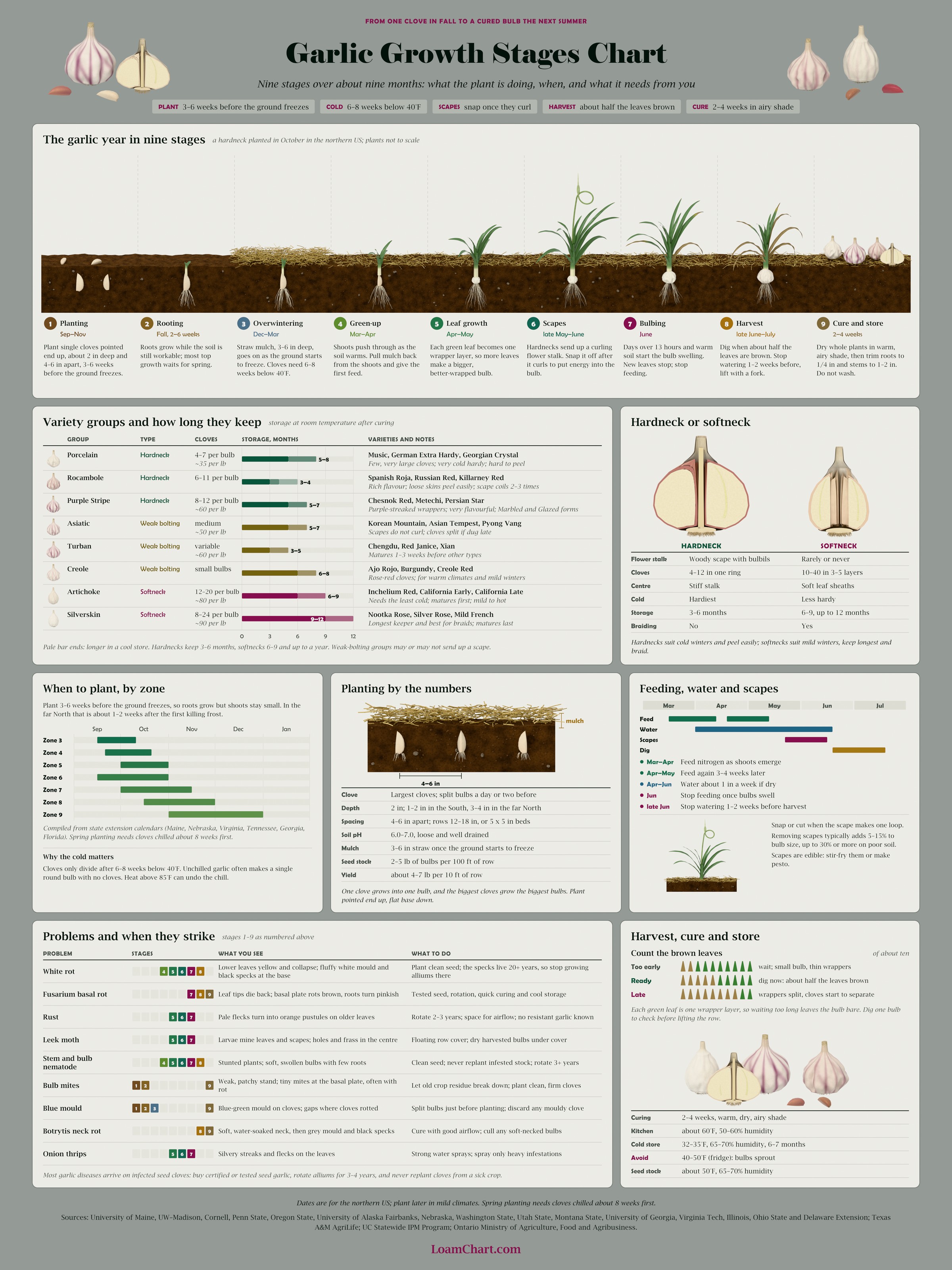
1.The nine stages of the garlic year
Garlic is planted as a single clove in fall, roots before winter, sits out the cold under mulch and does nearly all of its leaf and bulb growth between March and July. Choose a stage to see the plant and what it needs from you. The dates are typical for zones 5 and 6; growth starts earlier in mild climates.

Stage 1 · September to November
Planting
Plant single cloves pointed end up, about 2 in deep and 4–6 in apart, 3–6 weeks before the ground freezes.
What to doSplit bulbs into cloves a day or two before. Plant the biggest cloves 2 in deep and 4–6 in apart, flat base down.
Months shaded: when the stage usually happens, September to August.
Figure 2. Each stage stands in a bed cut open to show the clove or bulb and its roots. Bulbs are drawn larger than life so they show up.
2.Planting at the right time
Plant 3–6 weeks before the ground freezes. That gives the cloves time to root, but not enough warmth to push much top growth that winter could kill. Garlic also needs 6–8 weeks below 40°F before the bulb will divide into cloves, which is why it is planted in fall. Pick your zone, or enter the date your ground usually freezes.

| Clove | Largest cloves; split bulbs a day or two before |
|---|---|
| Depth | 2 in; 1–2 in in the South, 3–4 in in the far North |
| Spacing | 4–6 in apart; rows 12–18 in, or 5 x 5 in beds |
| Soil pH | 6.0–7.0, loose and well drained |
| Mulch | 3–6 in straw once the ground starts to freeze |
| Seed stock | 2–5 lb of bulbs per 100 ft of row |
| Yield | about 4–7 lb per 10 ft of row |
3.Hardneck and softneck garlic
Every garlic is one of two subspecies. Hardnecks send up a woody flower stalk, the scape, and form one ring of large cloves around it. Softnecks rarely bolt; their necks stay soft and pliable, and the cloves pack in several layers. Cut a bulb in half and the difference is plain to see.


| Hardneck | Softneck | |
|---|---|---|
| Flower stalk | Woody scape with bulbils | Rarely or never |
| Cloves | 4–12 in one ring | 10–40 in 3–5 layers |
| Centre | Stiff stalk | Soft leaf sheaths |
| Cold | Hardiest | Less hardy |
| Storage | 3–6 months | 6–9, up to 12 months |
| Braiding | No | Yes |
4.Eight variety groups compared
Garlic growers sort the named varieties into groups that share a look, a clove count and a storage life. Hardnecks suit cold winters; Creole and the softnecks suit mild ones. Storage times are for room conditions after curing; the paler bar end shows the longer life some groups reach in a cool store.

Porcelain
HardneckMusic, German Extra Hardy, Georgian Crystal
Few, very large cloves; very cold hardy; hard to peel.

Rocambole
HardneckSpanish Roja, Russian Red, Killarney Red
Rich flavour; loose skins peel easily; scape coils 2–3 times.

Purple Stripe
HardneckChesnok Red, Metechi, Persian Star
Purple-streaked wrappers; very flavourful; Marbled and Glazed forms.

Asiatic
Weak boltingKorean Mountain, Asian Tempest, Pyong Vang
Scapes do not curl; cloves split if dug late.

Turban
Weak boltingChengdu, Red Janice, Xian
Matures 1–3 weeks before other types.

Creole
Weak boltingAjo Rojo, Burgundy, Creole Red
Rose-red cloves; for warm climates and mild winters.

Artichoke
SoftneckInchelium Red, California Early, California Late
Needs the least cold; matures first; mild to hot.

Silverskin
SoftneckNootka Rose, Silver Rose, Mild French
Longest keeper and best for braids; matures last.
Figure 6. One bulb from each group. Clove counts per pound of seed garlic come from the University of Alaska Fairbanks; Rocambole and Creole were not given.
5.Feeding, water and scapes in spring
Garlic makes its leaves in spring and its bulb in early summer, and each leaf becomes one of the papery wrappers around the bulb. So the plant needs nitrogen and water while it is building leaves, and neither once the bulb begins to swell. Late nitrogen can shorten storage life.
- March to April: Feed nitrogen as shoots emerge.
- April to May: Feed again 3–4 weeks later.
- April to June: Water about 1 in a week if dry.
- June: Stop feeding once bulbs swell.
- Late June: Stop watering 1–2 weeks before harvest.

6.Knowing when to dig
A garlic plant has roughly ten leaves, and the lower ones die from the bottom up as the bulb matures. Each green leaf still above ground is a wrapper layer still around the bulb. Dig too early and the bulb is small; dig too late and the wrappers split, cloves separate and the bulb will not keep. Count the brown leaves on a typical plant.
Brown leaves out of 10
Lift with a fork, never pull by the stem, and keep the bulbs out of hot sun. Stop watering 1–2 weeks before harvest.

7.Curing and storing the crop
Freshly dug garlic needs to dry before it will keep. Hang it in bunches or spread whole plants on a rack in warm, dry, airy shade. When the necks are tight and the outer skins papery, trim the roots to about 1/4 in and the stems to 1–2 in. Brush off loose soil, but do not wash the bulbs.

| Curing | 2–4 weeks, warm, dry, airy shade |
|---|---|
| Kitchen | about 60°F, 50–60% humidity |
| Cold store | 32–35°F, 65–70% humidity, 6–7 months |
| Avoid | 40–50°F (fridge): bulbs sprout |
| Seed stock | about 50°F, 65–70% humidity |
| Shelf life | Hardnecks 3–6 months, softnecks 6–9 and up to 12 |
8.Problems through the season
Most garlic troubles arrive on infected seed cloves, so the best defence is certified or tested seed garlic and a 3–4 year rotation away from onions, leeks and their relatives. Pick a stage to see what to watch for.
White rot
What you seeLower leaves yellow and collapse; fluffy white mould and black specks at the base
What to doPlant clean seed; the specks live 20+ years, so stop growing alliums there
Fusarium basal rot
What you seeLeaf tips die back; basal plate rots brown, roots turn pinkish
What to doTested seed, rotation, quick curing and cool storage
Rust
What you seePale flecks turn into orange pustules on older leaves
What to doRotate 2–3 years; space for airflow; no resistant garlic known
Leek moth
What you seeLarvae mine leaves and scapes; holes and frass in the centre
What to doFloating row cover; dry harvested bulbs under cover
Stem and bulb nematode
What you seeStunted plants; soft, swollen bulbs with few roots
What to doClean seed; never replant infested stock; rotate 3+ years
Bulb mites
What you seeWeak, patchy stand; tiny mites at the basal plate, often with rot
What to doLet old crop residue break down; plant clean, firm cloves
Blue mould
What you seeBlue-green mould on cloves; gaps where cloves rotted
What to doSplit bulbs just before planting; discard any mouldy clove
Botrytis neck rot
What you seeSoft, water-soaked neck, then grey mould and black specks
What to doCure with good airflow; cull any soft-necked bulbs
Onion thrips
What you seeSilvery streaks and flecks on the leaves
What to doStrong water sprays; spray only heavy infestations
Sources and notes
Figures are from US university extension services and the Ontario agriculture ministry. Where sources disagree, the chart gives the common range: for example curing times run from 1 to 6 weeks and harvest signs from a third to half of the leaves brown. Planting windows by zone are compiled from state planting calendars and the 3–6 week rule.
- University of Maine Cooperative Extension. Bulletin #2063, Growing Garlic in Maine.
- University of Maine Cooperative Extension. Maine Garlic Pest Field Notebook.
- UW-Madison Division of Extension. Garlic, Allium sativum (Wisconsin Horticulture).
- Cornell CALS. Plan on Garlic This Fall.
- Cornell Cooperative Extension Warren County. Garlic.
- Penn State Extension. Garlic Production.
- Oregon State University Extension. Garlic (Fall).
- Oregon State University Department of Horticulture. Garlic, Oregon Vegetables.
- University of Alaska Fairbanks Cooperative Extension. Growing Garlic in Alaska (HGA-00047).
- University of Nebraska-Lincoln Extension. Garlic Production in the Home Garden (G2221).
- Washington State University Extension. Growing Garlic in Home Gardens (FS162E).
- Utah State University Extension. How to Grow Garlic in Your Garden.
- Montana State University Extension. Growing Garlic in Montana (MontGuide).
- University of Georgia Extension. Garlic Production for the Gardener (C854).
- Virginia Cooperative Extension. Virginia's Home Garden Vegetable Planting Guide (426-331).
- University of Illinois Extension. Planting and Growing Garlic.
- Ohio State University CFAES. Growing Garlic in the Garden (HYG-1627).
- University of Delaware Cooperative Extension. Garlic Scapes (Weekly Crop Update).
- UC Statewide IPM Program. White Rot; Rust; Fusarium Basal Rot.
- Texas A&M AgriLife Extension. Garlic (J. Masabni).
- Ontario Ministry of Agriculture, Food and Agribusiness. Garlic production.