
Egg Size Chart
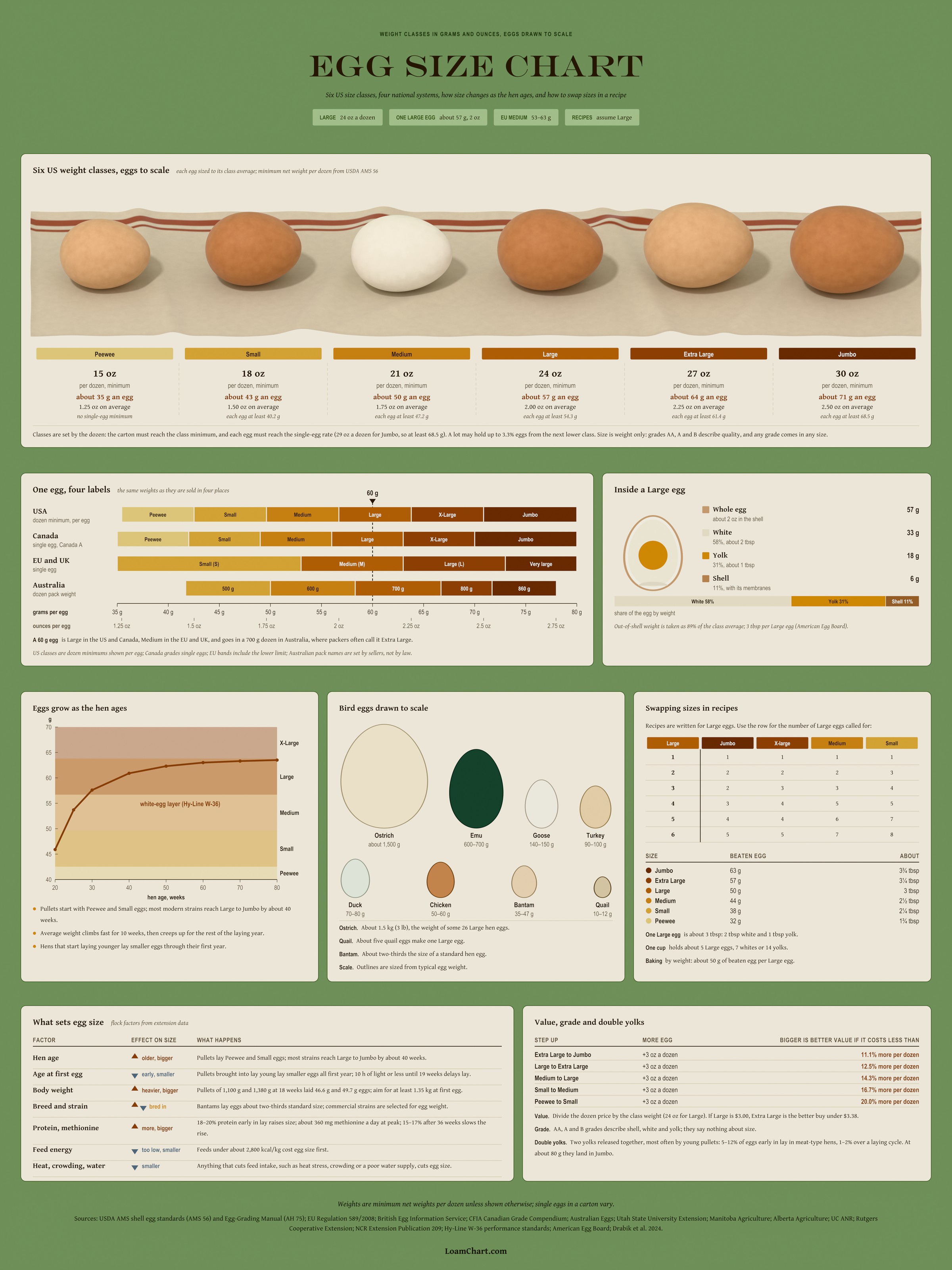
Egg sizes are weight classes, not measurements. This chart gives the six US classes in ounces and grams, the Canadian, EU and UK and Australian systems beside them, how to swap sizes in a recipe, how egg size changes as a hen ages, and how a hen egg compares with the eggs of seven other birds.
1.Six US weight classes
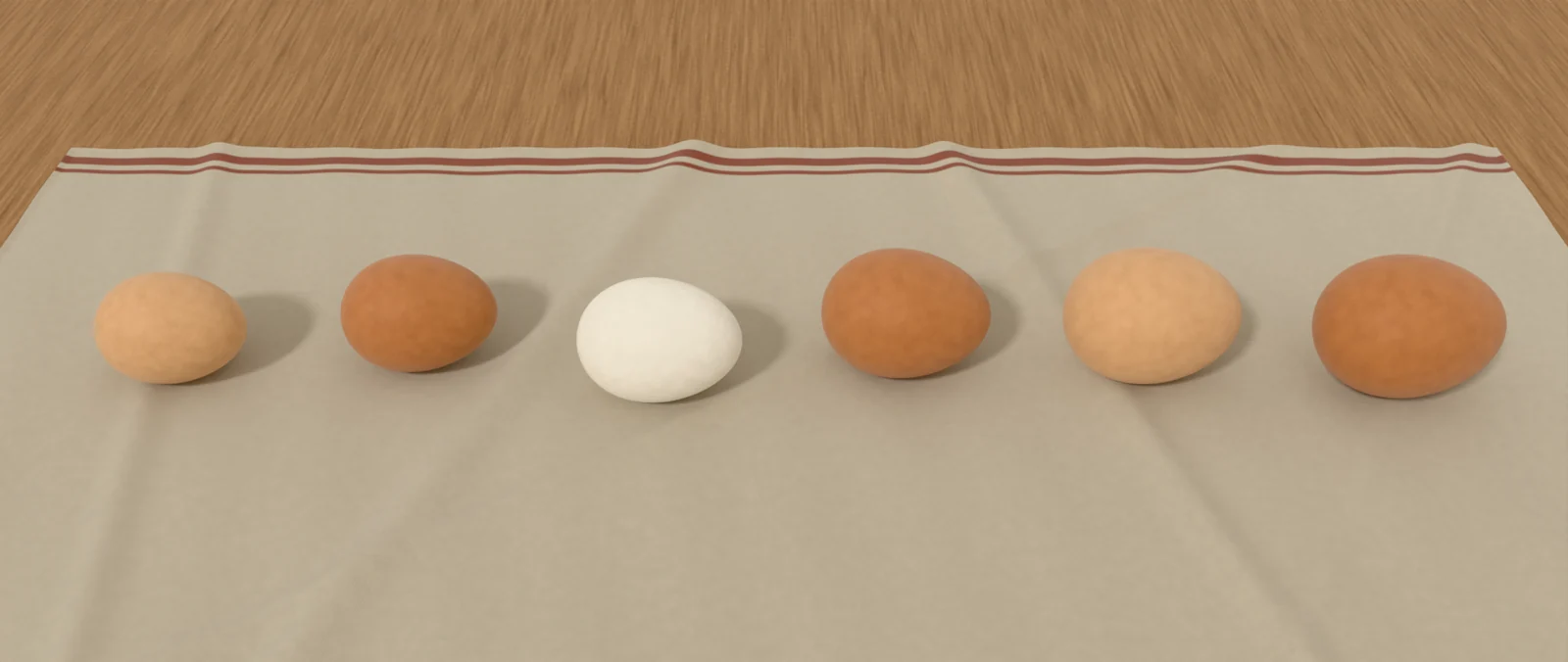
US egg sizes are set by the USDA as a minimum net weight for a dozen eggs. Each class steps up by 3 oz a dozen, so each egg in the next class up weighs about a quarter of an ounce (7 g) more. Size says nothing about quality: grades AA, A and B describe the shell, white and yolk, and any grade can come in any size.
| Size | Per dozen, minimum | Average egg | Lightest single egg | 30 dozen, minimum |
|---|---|---|---|---|
| Jumbo | 30 oz (850 g) | 70.9 g, 2.50 oz | 68.5 g | 56 lb |
| Extra Large | 27 oz (765 g) | 63.8 g, 2.25 oz | 61.4 g | 50½ lb |
| Large | 24 oz (680 g) | 56.7 g, 2.00 oz | 54.3 g | 45 lb |
| Medium | 21 oz (595 g) | 49.6 g, 1.75 oz | 47.2 g | 39½ lb |
| Small | 18 oz (510 g) | 42.5 g, 1.50 oz | 40.2 g | 34 lb |
| Peewee | 15 oz (425 g) | 35.4 g, 1.25 oz | none set | 28 lb |
The lightest single egg is the USDA rate per dozen for individual eggs (29 oz a dozen for Jumbo, for example) shown per egg. A lot may hold up to 3.3% eggs from the next lower class, with no single case over 5%.
2.Weigh an egg to find its size
Put an egg on a kitchen scale and enter its weight. The table shows the size it matches in each of the four systems. For a fair answer, weigh a dozen and divide by twelve: US sizes are set for the dozen, not the single egg.
| USA | Large |
|---|---|
| Canada | Large |
| EU and UK | Medium (M) |
| Australia | 700 g dozen pack |
3.Four countries, four sets of labels
The same egg can carry different names. US and Canadian sizes share their names, but Canada grades each egg by its own weight. The EU and UK use four bands, so their Medium is about the weight of an American Large. Australian packers sell by the weight of the dozen pack, and the names on the carton are their own.
Bands run from 35 to 80 g per egg. The dashed line follows the weight entered in section 2.
| Pack | Egg weights | Average egg | Edible part |
|---|---|---|---|
| 500 g | 41.7–49.9 g | 43 g | 37 g |
| 600 g | 50.0–58.2 g | 52 g | 45 g |
| 700 g | 58.3–66.6 g | 60 g | 52 g |
| 800 g | 66.7–71.6 g | 68 g | 59 g |
| 860 g | 71.7–78.0 g | 73 g | 64 g |
4.Swapping egg sizes in recipes
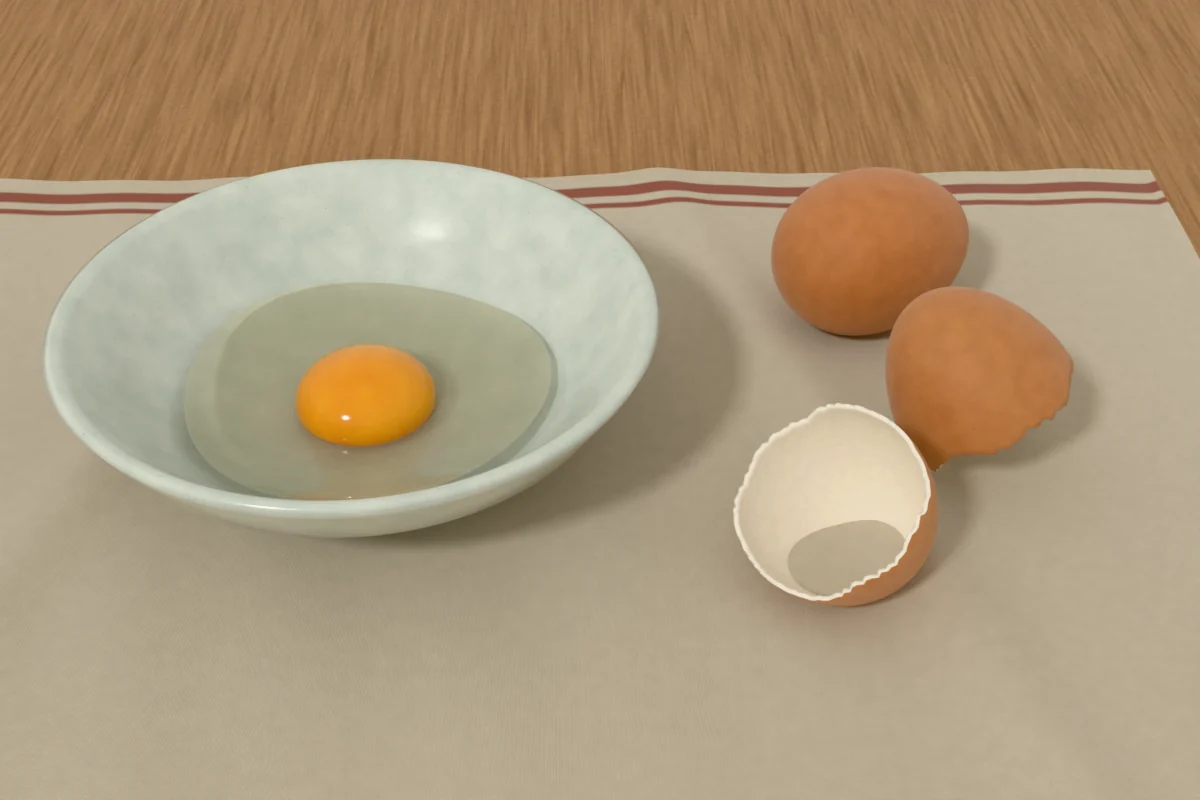
Cookbooks in the US and Canada write for Large eggs. One Large egg gives about 3 tablespoons of beaten egg: 2 of white and 1 of yolk. For one or two eggs the size hardly matters; in cakes, custards and pasta dough calling for four or more, swap by the table or by weight.
| Large | Jumbo | Extra Large | Medium | Small |
|---|---|---|---|---|
| 1 | 1 | 1 | 1 | 1 |
| 2 | 2 | 2 | 2 | 3 |
| 3 | 2 | 3 | 3 | 4 |
| 4 | 3 | 4 | 5 | 5 |
| 5 | 4 | 4 | 6 | 7 |
| 6 | 5 | 5 | 7 | 8 |
| Size | Beaten egg | About |
|---|---|---|
| Jumbo | 63 g | 3¾ tbsp |
| Extra Large | 57 g | 3½ tbsp |
| Large | 50 g | 3 tbsp |
| Medium | 44 g | 2¾ tbsp |
| Small | 38 g | 2¼ tbsp |
| Peewee | 32 g | 2 tbsp |
Beaten egg is taken as 89% of the class average weight (the shell is about 11%). One cup holds about 5 Large eggs, 7 whites or 14 yolks.
5.Eggs grow as the hen ages
A pullet's first eggs are Peewee and Small. Egg weight climbs quickly over the first ten weeks of lay, then creeps up for the rest of the laying year, and most modern strains reach Large to Jumbo by about 40 weeks of age. Move the slider to see the average for a commercial white-egg layer.
Hy-Line W-36 performance standards (2020), average egg weight. Brown-egg strains and small flocks run their own curves; heavier pullets and richer feed early in lay give bigger eggs sooner.
6.What sets egg size in a flock
Age matters most, but a flock keeper can move egg size a little with how pullets are grown and fed. Figures are from Manitoba Agriculture and Alberta Agriculture.
- Hen age▲ older, biggerPullets lay Peewee and Small eggs; most strains reach Large to Jumbo by about 40 weeks.
- Age at first egg▼ early, smallerPullets brought into lay young lay smaller eggs all through their first year. Ten hours of light or less until 19 weeks delays the start of lay.
- Body weight▲ heavier, biggerPullets weighing 1,100 g and 1,380 g at 18 weeks laid eggs averaging 46.6 g and 49.7 g; aim for at least 1.35 kg at the first egg.
- Breed and strain▲▼ bred inBantams lay eggs about two-thirds standard size; commercial strains are selected for egg weight.
- Protein and methionine▲ more, biggerAn 18–20% protein ration in the first months of lay raises egg size, with about 360 mg methionine a day at peak. Dropping to 15–17% after 36 weeks slows the rise.
- Feed energy▼ too low, smallerFeeds below about 2,800 kcal/kg cost egg size before anything else.
- Heat, crowding and water▼ smallerAnything that cuts feed intake, such as heat stress, crowding or a poor water supply, cuts egg size too.
7.Bird eggs at true relative size
A hen's egg sits in the middle of the range. Ostrich eggs are the largest laid by any living bird; a quail egg is about a fifth the weight of a Large hen egg.
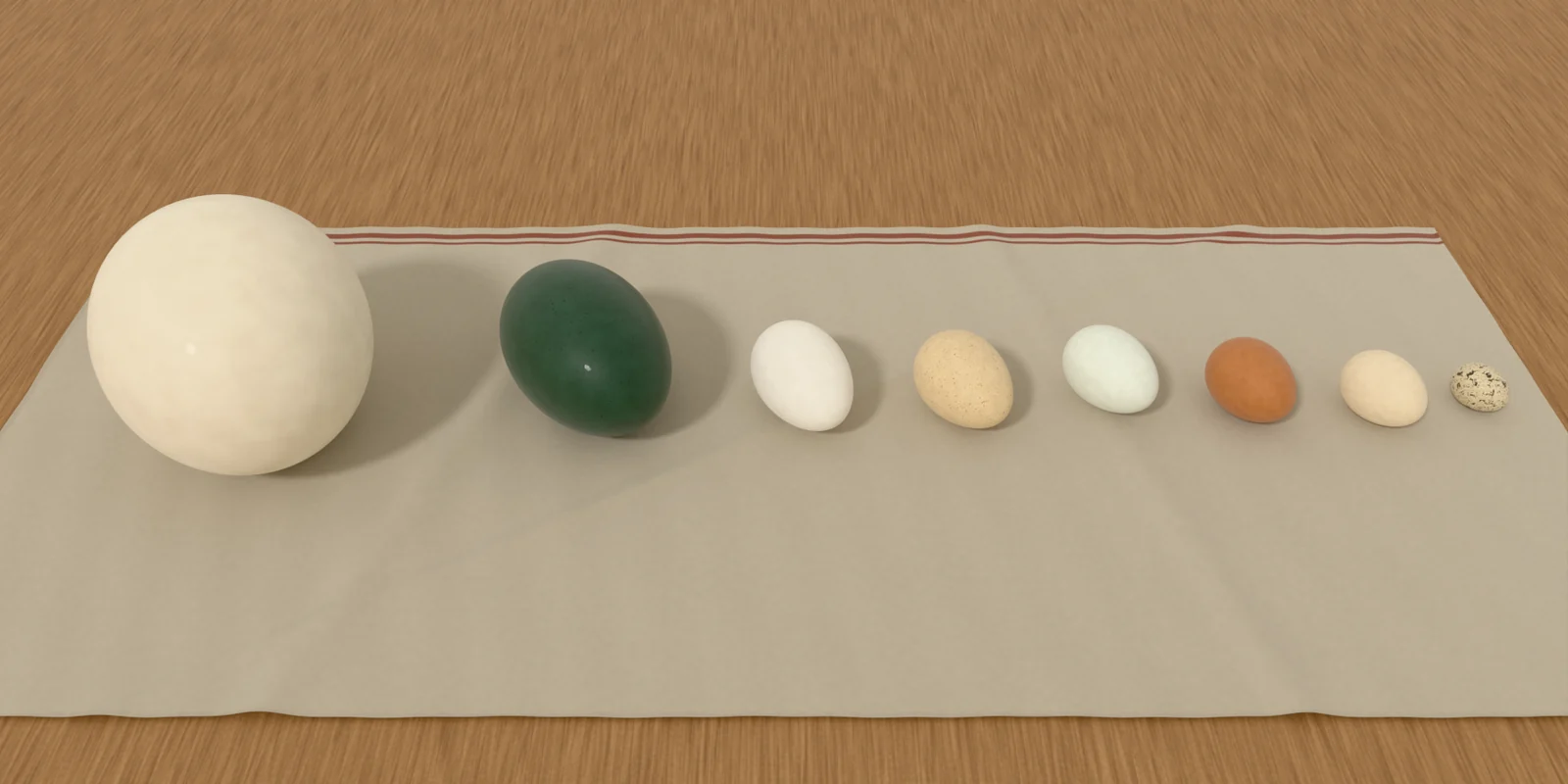
By weight, using the middle of each range. Egg weights from UC ANR, Rutgers Cooperative Extension and NCR Extension Publication 209 (bantams).
8.Value per ounce, grade and double yolks
Because each US class is a fixed weight per dozen, the better buy is easy to work out: divide the price by the ounces in the dozen. Moving up one size gives 11–20% more egg, so the bigger size wins whenever it costs less than that much more.
| Step | More egg |
|---|---|
| Extra Large to Jumbo | +11.1% |
| Large to Extra Large | +12.5% |
| Medium to Large | +14.3% |
| Small to Medium | +16.7% |
| Peewee to Small | +20.0% |
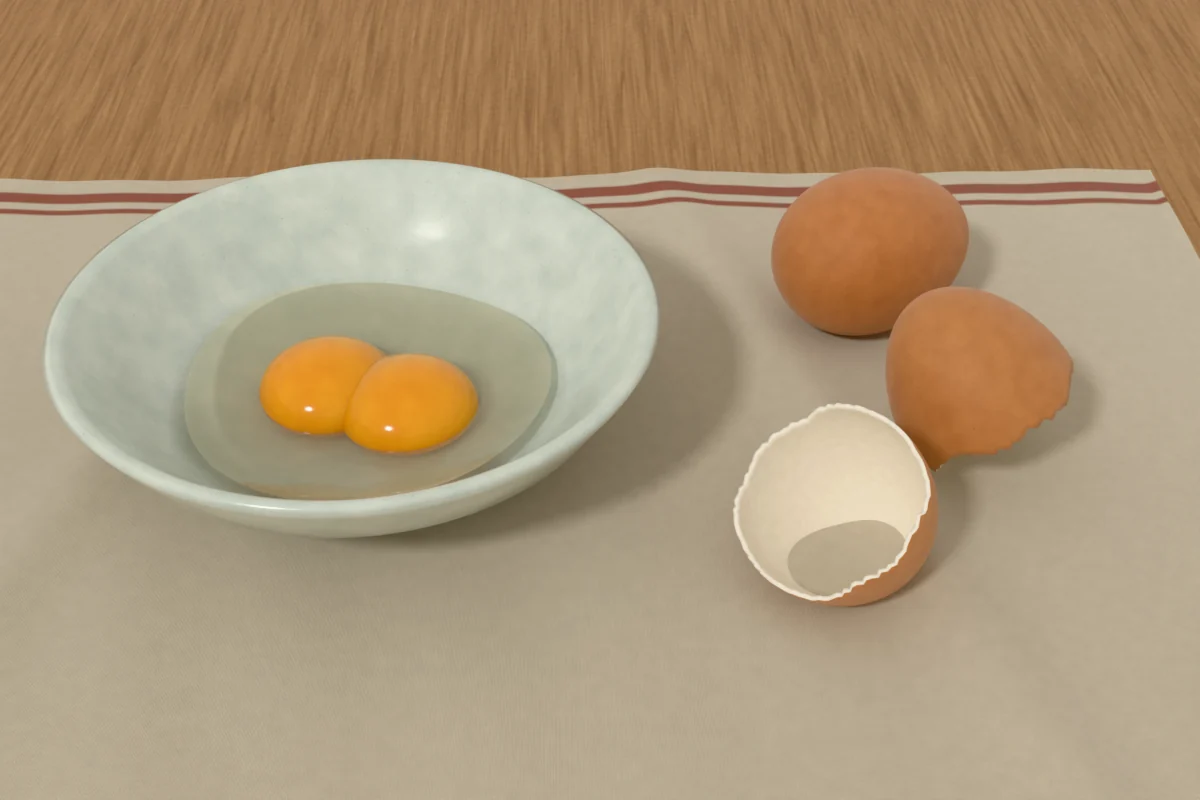
AA, A and B grades describe the shell, the air cell, the white and the yolk. Any grade can be any size.
Two yolks released almost together, most often by young pullets whose laying cycle has not settled. In one study they made up 5–12% of eggs at the start of lay in meat-type hens and 1–2% over a whole laying cycle, and averaged 80 g against 55 g for single-yolk eggs: Jumbo size.
US classes allow a little spread: a lot may hold up to 3.3% eggs from the next lower class, so the odd egg in a Large carton can weigh less than its neighbours.
Sources and notes
US classes are the minimum net weights per dozen for consumer grades; the per-egg figures on this page are those weights divided by twelve. Canadian, EU and UK classes apply to single eggs. Australian pack names are set by sellers. Species weights are typical ranges; individual eggs vary widely.
- USDA Agricultural Marketing Service: United States Standards, Grades, and Weight Classes for Shell Eggs (AMS 56)
- USDA Agricultural Marketing Service: Egg-Grading Manual, Agricultural Handbook 75
- Commission Regulation (EC) No 589/2008: Article 4, weight grading of eggs
- British Egg Information Service: Egg sizes
- Canadian Food Inspection Agency: Canadian Grade Compendium: Volume 5, Eggs
- Utah State University Extension: Egg quality, safety and flock health, Small Acreage Livestock series (extension.usu.edu)
- Australian Eggs: Egg types and labels
- Australian Eggs: Collecting, grading and sizing eggs
- Manitoba Agriculture: Egg Size and Your Small Flock of Laying Hens
- Alberta Agriculture: Enhancing Early Egg Size and Maintaining Shell Quality in Layers
- Hy-Line International: W-36 Commercial Layers, performance standards (2020)
- What's Cooking America, after the American Egg Board: Egg Size Equivalents
- UC Agriculture and Natural Resources: Poultry, Small Acreage Landowners
- Rutgers Cooperative Extension: Ostrich, Emu, and Rhea Production (FS886)
- J. L. Skinner, NCR Extension Publication 209: Bantams
- Drabik et al., Animals 14:1568 (2024): Quality and chemical composition of double-yolked eggs