
Egg Candling Chart
What a candling lamp shows inside a chicken egg on each of the 21 days of incubation, the signs that mean an egg should come out, how to read the air cell, and hatch dates for eleven kinds of poultry.
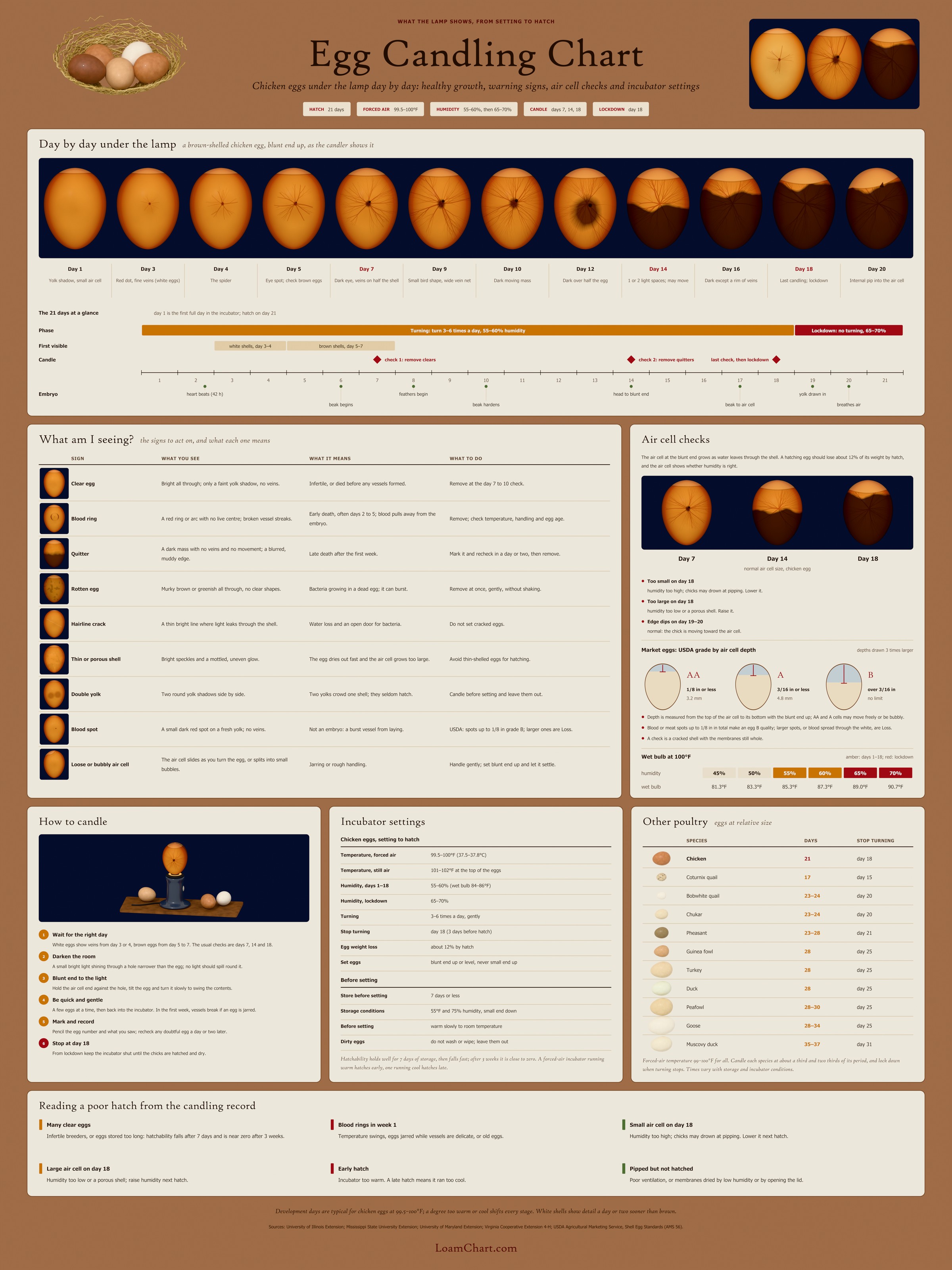
1.The egg day by day
Move the slider or pick a day. The picture shows a brown-shelled chicken egg held blunt end up against the lamp; white shells show the same features a day or two sooner. Day 1 is the first full day in the incubator.
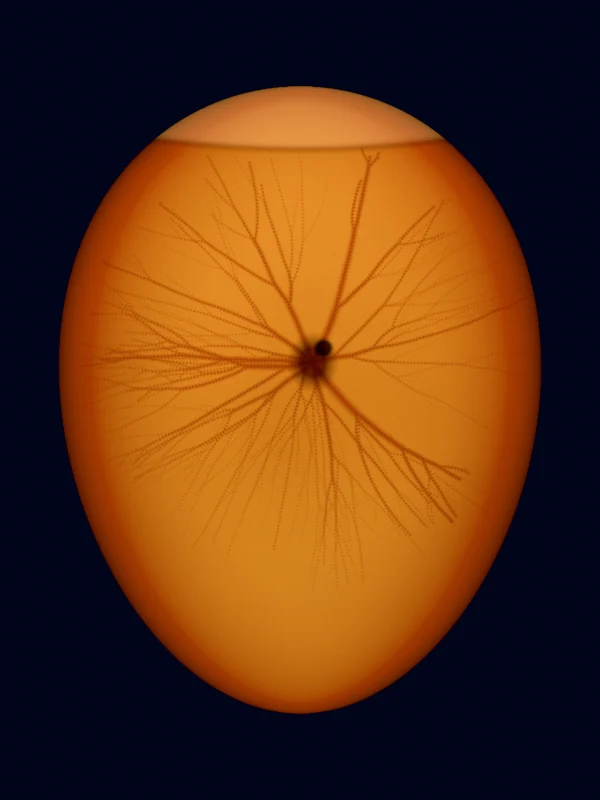
Day 7
Turning, candling day| The lamp shows | Dark eye, curled body and veins over about half the shell: the standard first candling. |
|---|---|
| Inside the egg | Toes and wing digits show; the abdomen swells as organs grow. |
| What to do | Candle: the first standard check. Remove clear eggs and blood rings. |
Figure 2. Development times from University of Illinois Extension and Mississippi State University Extension, for eggs held at 99.5–100°F.
2.Signs that an egg should come out
Pick a sign to see it under the lamp. Clear eggs and blood rings come out at the first check; doubtful eggs go back for a second look a day or two later. Dead eggs left in the incubator rot, and a rotten egg can burst over the others.

Blood ring
- WHAT YOU SEE
- A red ring or arc with no live centre; broken vessel streaks.
- WHAT IT MEANS
- Early death, often days 2 to 5; blood pulls away from the embryo.
- WHAT TO DO
- Remove; check temperature, handling and egg age.
3.The air cell tells you the humidity
Water leaves the egg through the shell all through incubation, and the air cell at the blunt end grows to take its place. A hatching egg should lose about 12% of its weight by hatch. Compare your eggs with the normal air cell on days 7, 14 and 18, and adjust the humidity before lockdown.
Air cell check

Market eggs: USDA grade by air cell depth
| Quality | Air cell depth | Movement |
|---|---|---|
| AA | 1/8 in (3.2 mm) or less | may move freely or be bubbly |
| A | 3/16 in (4.8 mm) or less | may move freely or be bubbly |
| B | over 3/16 in | may move freely or be bubbly |
Depth runs from the top of the air cell to its bottom with the blunt end up. Blood or meat spots up to 1/8 in in total make an egg B quality; larger spots, or blood spread through the white, are Loss. A check is a cracked shell with the membranes still whole.
| Humidity | Wet bulb | Use |
|---|---|---|
| 45% | 81.3°F | below the 55–60% setting range |
| 50% | 83.3°F | below the 55–60% setting range |
| 55% | 85.3°F | days 1–18 |
| 60% | 87.3°F | days 1–18 |
| 65% | 89.0°F | lockdown and hatch |
| 70% | 90.7°F | lockdown and hatch |
4.How to candle without harming the embryo
Any bright, narrow light works: a purpose-made candler, or a bulb in a box with a small round hole. The room must be dark so the only light you see is the light coming through the egg.
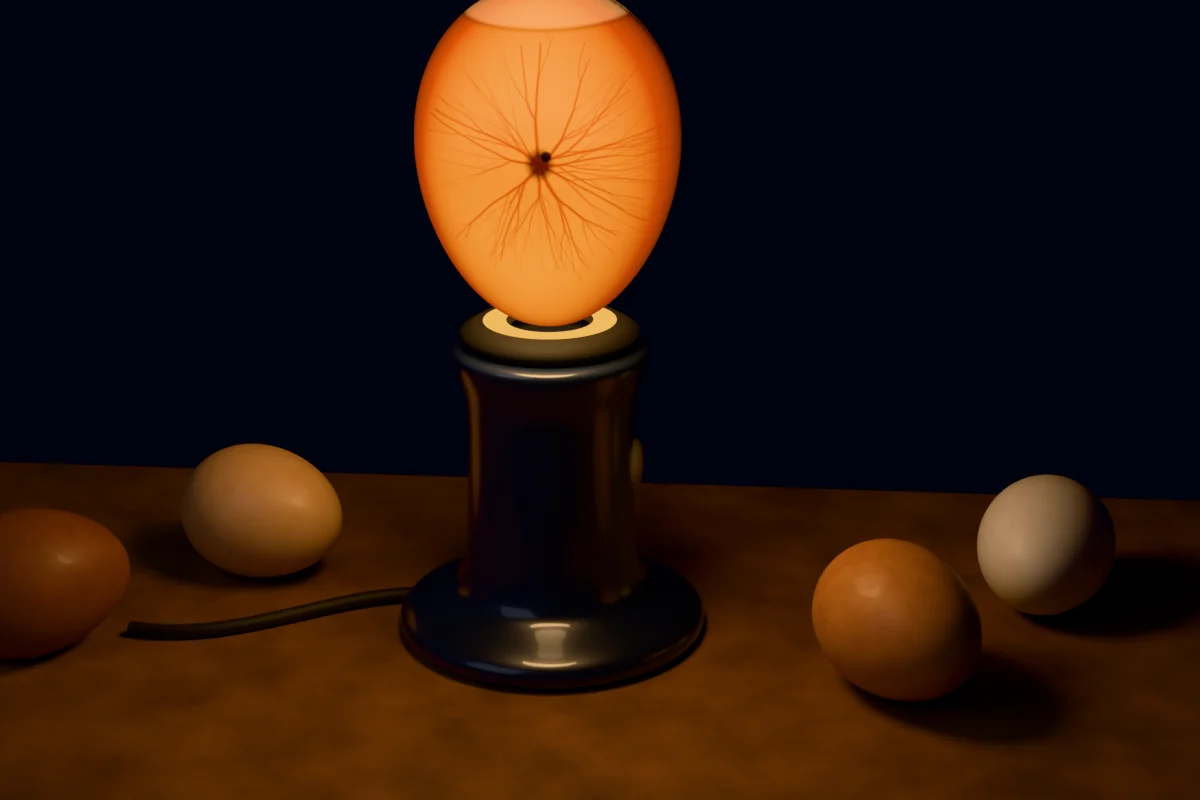
- Wait for the right dayWhite eggs show veins from day 3 or 4, brown eggs from day 5 to 7. The usual checks are days 7, 14 and 18.
- Darken the roomA small bright light shining through a hole narrower than the egg; no light should spill round it.
- Blunt end to the lightHold the air cell end against the hole, tilt the egg and turn it slowly to swing the contents.
- Be quick and gentleA few eggs at a time, then back into the incubator. In the first week, vessels break if an egg is jarred.
- Mark and recordPencil the egg number and what you saw; recheck any doubtful egg a day or two later.
- Stop at day 18From lockdown keep the incubator shut until the chicks are hatched and dry.
5.Incubator settings for chicken eggs
Most poor hatches come from temperature or humidity held too high or too low for too long. Check the thermometer against a clinical one: an error of one degree over 21 days is enough to spoil a hatch.
| Temperature, forced air | 99.5–100°F (37.5–37.8°C) |
|---|---|
| Temperature, still air | 101–102°F at the top of the eggs |
| Humidity, days 1–18 | 55–60% (wet bulb 84–86°F) |
| Humidity, lockdown | 65–70% |
| Turning | 3–6 times a day, gently |
| Stop turning | day 18 (3 days before hatch) |
| Egg weight loss | about 12% by hatch |
| Set eggs | blunt end up or level, never small end up |
| Store before setting | 7 days or less |
|---|---|
| Storage conditions | 55°F and 75% humidity, small end down |
| Before setting | warm slowly to room temperature |
| Dirty eggs | do not wash or wipe; leave them out |

6.Hatch dates for other poultry
Choose a species and the day you set the eggs. The table gives the candling days, the day to stop turning and the hatch date. Periods are those listed by Mississippi State University; storage and incubator conditions can move them by a day or so.
| Set the eggs | day 0 | Wed 1 Apr |
|---|---|---|
| First candling | day 7 | Wed 8 Apr |
| Second candling | day 14 | Wed 15 Apr |
| Last candling, stop turning | day 18 | Sun 19 Apr |
| Hatch | day 21 | Wed 22 Apr |
Day 1 is the first full day after setting. Candling days for species other than chicken are set at about a third and two thirds of the period.

7.Reading a poor hatch
Keep the candling record. When a hatch goes badly, the day the eggs failed points to the cause.
Infertile breeders, or eggs stored too long: hatchability falls after 7 days and is near zero after 3 weeks.
Temperature swings, eggs jarred while vessels are delicate, or old eggs.
Humidity too high; chicks may drown at pipping. Lower it next hatch.
Humidity too low or a porous shell; raise humidity next hatch.
Incubator too warm. A late hatch means it ran too cool.
Poor ventilation, or membranes dried by low humidity or by opening the lid.
Sources and notes
Days and settings are for chicken eggs in a forced-air incubator unless stated. Extension services differ slightly on humidity and turning; the ranges here cover their advice. Development days are typical and shift by a day or more with incubator temperature.
- University of Illinois Extension: Candling Eggs
- University of Illinois Extension: Embryonic Development Times
- Mississippi State University Extension: Testing Incubated Eggs for Embryo Development
- Mississippi State University Extension: Stages of Chick Embryo Development
- Mississippi State University Extension: Incubation Duration Periods
- Mississippi State University Extension: Pipped Eggs Do Not Hatch
- T. W. Smith, Mississippi State University: Care and Incubation of Hatching Eggs
- University of Maryland Extension: Hatching Eggs at Home (FS-1114)
- Virginia Cooperative Extension, Fauquier County 4-H: Embryology Tips
- USDA Agricultural Marketing Service: United States Standards, Grades, and Weight Classes for Shell Eggs (AMS 56)