
Pickling
pale, blocky, warty, black or white spines · Calypso, County Fair, Boston Pickling
pick at 2–4 in
48–58 days from seed
 LoamChart
Home Cucumber Growth Stages Chart
Ten stages from a flat white seed in warm soil to cucumbers you pick every day or two, with the days each takes, what the vine needs and what goes wrong. Work out your sowing and picking dates, check a fruit against the picking size for its type, and find the cause of a problem.
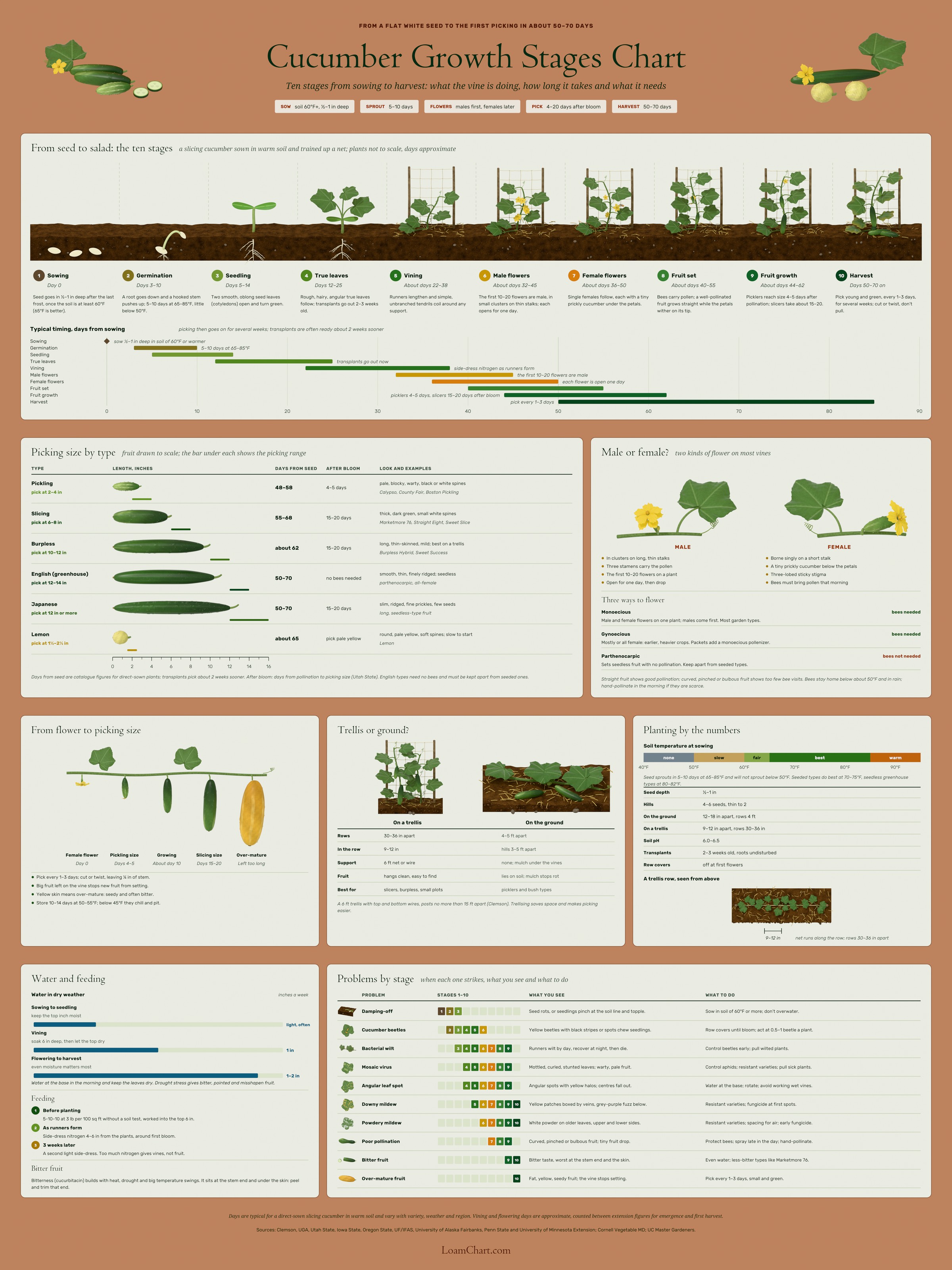
A slicing cucumber sown in warm soil gives its first fruit in roughly 50–70 days and then keeps cropping for weeks if you keep picking. Move the slider through the season, or pick a stage, to see the plant, what is happening and what it needs. Emergence and fruit timing come from extension figures; the vining and flowering days in between are approximate.

Day 0
Figure 3. Typical timing in days from sowing for a slicing cucumber. Picklers come a few days sooner; transplants are often ready about 2 weeks sooner.
Pick a type, then either the day you plan to sow or the day you want the first cucumbers. The calculator counts with the type’s days to harvest and lays out the stages in between. Cucumbers are tender: sow after the last frost, once the soil is at least 60°F.
| Sow in the garden | May 20 | ½–1 in deep, 4–6 seeds per hill or 4–5 per foot along a trellis |
|---|---|---|
| Seedlings up | May 25 to May 30 | 5–10 days at 65–85°F |
| Runners form | Jun 15 to Jun 23 | side-dress nitrogen; train vines onto the trellis (approximate) |
| First male flowers | Jun 25 to Jul 3 | approximate; the first 10–20 flowers set no fruit |
| Female flowers | Jun 30 to Jul 8 | bees must visit; take row covers off |
| First picking, about | Jul 21, 2026 | at 6–8 in; 62 days |
| Keep picking | Jul 21 to Aug 11 | every 1–3 days; field crops are often picked for 2–3 weeks or more |
Add your average last spring frost date to check the date against it.
Cucumbers taste best young and green, and the right size depends on the type: a pickler is ready at a few inches, an English cucumber at more than a foot. Choose a type and measure one of yours to see whether it is ready.

Picking range in inches (green) and your measurement (red line).
| Pick at | 6–8 in |
|---|---|
| Thickness | 1½–2 in |
| Days from seed | 55–68 |
| After bloom | 15–20 days |
| Look | thick, dark green, small white spines |
| Examples | Marketmore 76, Straight Eight, Sweet Slice |
| Source | Iowa State; UGA; Utah State |
pale, blocky, warty, black or white spines · Calypso, County Fair, Boston Pickling
pick at 2–4 in
48–58 days from seed
thick, dark green, small white spines · Marketmore 76, Straight Eight, Sweet Slice
pick at 6–8 in
55–68 days from seed

long, thin-skinned, mild; best on a trellis · Burpless Hybrid, Sweet Success
pick at 10–12 in
about 62 days from seed

smooth, thin, finely ridged; seedless · parthenocarpic, all-female
pick at 12–14 in
50–70 days from seed

slim, ridged, fine prickles, few seeds · long, seedless-type fruit
pick at 12 in or more
50–70 days from seed

round, pale yellow, soft spines; slow to start · Lemon
pick at 1½–2½ in
about 65 days from seed
Figure 5. Days from seed are catalogue figures for direct-sown plants (UGA, UC Master Gardeners, University of Alaska Fairbanks). After bloom: days from pollination to picking size (Utah State).
Most cucumber vines carry both kinds of flower. The first 10–20 are male and set no fruit, which is why a young vine can bloom for a week without a single cucumber. Each flower opens for one day, and a female needs bees to bring pollen that morning.


Figure 6. The quickest check is behind the petals: only a female has the baby cucumber.
| Type | What it does | Bees |
|---|---|---|
| Monoecious | Male and female flowers on one plant; males come first. Most garden types. | needed |
| Gynoecious | Mostly or all female: earlier, heavier crops. Packets add a monoecious pollenizer. | needed |
| Parthenocarpic | Sets seedless fruit with no pollination. Keep apart from seeded types. | not needed |
Straight fruit shows good pollination; curved, pinched or bulbous fruit shows too few bee visits. Bees stay home below about 50°F and in rain; hand-pollinate in the morning if they are scarce. (Penn State, Oregon State, Clemson)
Protect the bees: spray only early or late in the day, when they are not working the flowers, and take row covers off as soon as the first flowers open (Iowa State, UGA).
Once a female flower is pollinated the fruit grows fast. Utah State gives about 4–5 days from pollination to picking size for picklers and about 15–20 for slicers. Left longer, the fruit fattens, turns yellow and seedy, and the vine slows down.

Bitterness (cucurbitacin) builds with heat, drought and big temperature swings. It sits at the stem end and under the skin: peel and trim that end. Iowa State lists Sweet Slice, Sweet Success and Marketmore 76 as less prone to it.
Vining cucumbers climb happily with their simple tendrils. A trellis saves space and keeps the fruit off the soil, where it is easy to find; picklers and bush types do well sprawling on mulch.
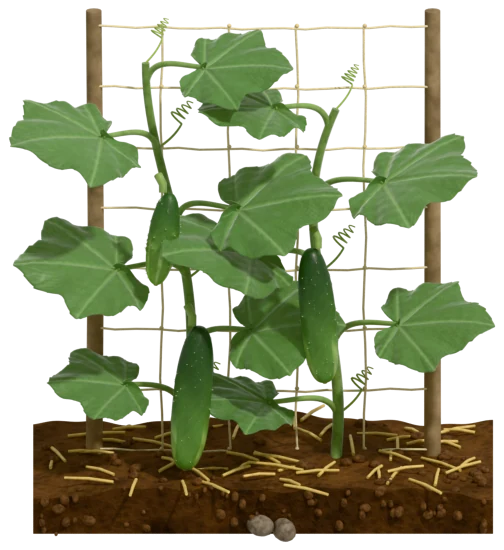
On a trellis
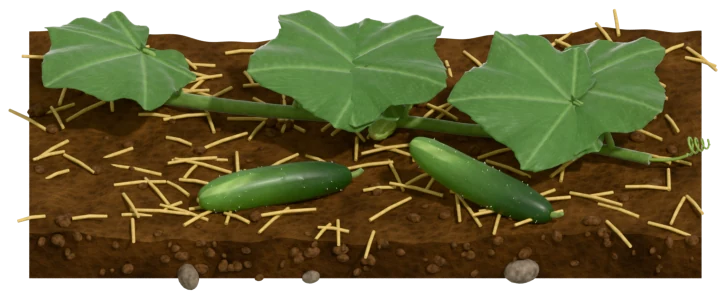
On the ground
| On a trellis | On the ground | |
|---|---|---|
| Rows | 30–36 in apart | 4–5 ft apart |
| In the row | 9–12 in | hills 3–5 ft apart |
| Support | 6 ft net or wire | none; mulch under the vines |
| Fruit | hangs clean, easy to find | lies on soil; mulch stops rot |
| Best for | slicers, burpless, small plots | picklers and bush types |
A 6 ft trellis with top and bottom wires, posts no more than 15 ft apart (Clemson). Trellising saves space and makes picking easier. Spacing from Clemson, UGA, Iowa State and Utah State.
Cucumber seed will not sprout below 50°F and comes up in 5–10 days at 65–85°F. Check a soil reading below, then use the spacing, water and feeding figures for the rest of the season.
Measure at seed depth in the morning. UGA and Iowa State wait for 60°F, Utah State and Oregon State for 65°F, and Clemson for 70°F.

| Soil temperature | 60°F or more, 65°F better |
|---|---|
| Seed depth | ½–1 in |
| Hills | 4–6 seeds, thin to 2 |
| On the ground | 12–18 in apart, rows 4 ft |
| On a trellis | 9–12 in apart, rows 30–36 in |
| Soil pH | 6.0–6.5 |
| Transplants | 2–3 weeks old, roots undisturbed |
| Row covers | off at first flowers |
| Storage | 10–14 days at 50–55°F |
| Stage | How | A week |
|---|---|---|
| Sowing to seedling | keep the top inch moist | light, often |
| Vining | soak 6 in deep, then let the top dry | about 1 in |
| Flowering to harvest | even moisture matters most | 1–2 in |
Water at the base in the morning and keep the leaves dry. Drought stress gives bitter, pointed and misshapen fruit. Utah State gives 1–2 in a week; Clemson says soak the soil at least 6 in deep.
Most cucumber troubles arrive at a predictable point in the season. Pick the stage your plants are at, or what you are seeing, to narrow the list.
10 of 10 problems across the season.

What you see: Seed rots, or seedlings pinch at the soil line and topple.
What to do: Sow in soil of 60°F or more; don't overwater.
Oregon State; Clemson

What you see: Yellow beetles with black stripes or spots chew seedlings.
What to do: Row covers until bloom; act at 0.5–1 beetle a plant.
University of Minnesota; Iowa State

What you see: Runners wilt by day, recover at night, then die.
What to do: Control beetles early; pull wilted plants.
University of Minnesota; Iowa State; UGA

What you see: Mottled, curled, stunted leaves; warty, pale fruit.
What to do: Control aphids; resistant varieties; pull sick plants.
Cornell; Utah State; Oregon State

What you see: Angular spots with yellow halos; centres fall out.
What to do: Water at the base; rotate; avoid working wet vines.
Cornell; UGA

What you see: Yellow patches boxed by veins, grey-purple fuzz below.
What to do: Resistant varieties; fungicide at first spots.
Cornell; UF/IFAS

What you see: White powder on older leaves, upper and lower sides.
What to do: Resistant varieties; spacing for air; early fungicide.
Cornell; Utah State

What you see: Curved, pinched or bulbous fruit; tiny fruit drop.
What to do: Protect bees; spray late in the day; hand-pollinate.
Penn State; Iowa State

What you see: Bitter taste, worst at the stem end and the skin.
What to do: Even water; less-bitter types like Marketmore 76.
Iowa State; Clemson; Oregon State

What you see: Fat, yellow, seedy fruit; the vine stops setting.
What to do: Pick every 1–3 days, small and green.
Iowa State; UGA
Stage days are typical for a direct-sown slicing cucumber in warm soil. Emergence comes from Utah State (5–10 days at 65–85°F), the first flowers from Clemson and fruit timing (4–5 days after pollination for picklers, 15–20 for slicers) from Utah State; the vining and flowering days are approximate, counted between them. Picking sizes are from Iowa State, Clemson, Utah State, UF/IFAS, the University of Alaska Fairbanks and the UC Master Gardeners; days from seed from UGA and the same sources.